Nov 2, 2026
Why Everyone Is Switching to a Glass Waterless Aroma Diffuser in 2026?
The wellness and hospitality industries are placing greater emphasis on scenting systems that combine appearance, operational convenience, and consistent fragrance delivery. Glass Waterless Aroma Diffusers are increasingly considered by businesses looking for alternatives to conventional water-based ultrasonic devices. Instead of mixing Essential Oils with water, these devices typically use compressed-air atomization to disperse concentrated oils into fine airborne particles. For procurement teams, the shift is not only about product appearance. It also involves maintenance requirements, coverage expectations, oil consumption, customization options, and long-term sourcing reliability. According to Anderson & Richardson (2025), commercial scenting equipment is increasingly evaluated based on operational efficiency and application-specific performance rather than fragrance output alone.[1] This article will help buyers compare diffusion technologies, evaluate key technical specifications, assess suppliers, and build a more practical sourcing checklist for 2026.


Understanding Glass Waterless Aroma Diffusers: Technology and Benefits
How Waterless Diffusion Technology Works
Modern waterless diffusers typically use compressed-air atomization or Venturi-based airflow to disperse essential oils without adding water or applying direct heat. Pressurized airflow interacts with the oil feed system, breaking the liquid into fine particles that can remain suspended and gradually disperse through the surrounding space.
Particle size and coverage can vary depending on nozzle design, airflow pressure, oil viscosity, and operating mode. Some commercial units are designed for spaces approaching 1,000 square feet under suitable conditions, although actual coverage depends on ventilation and room layout. According to Chen & Martinez (2024), atomization performance is strongly influenced by airflow design and oil characteristics, making real-world testing important when comparing scenting systems.[2]
The QW004 model uses a Compressed Air System and is designed for low-power operation of around 2W. For buyers, the more useful evaluation point is not simply the advertised coverage area, but whether the diffuser can maintain relatively consistent fragrance distribution across the intended environment.
Superior Material Composition
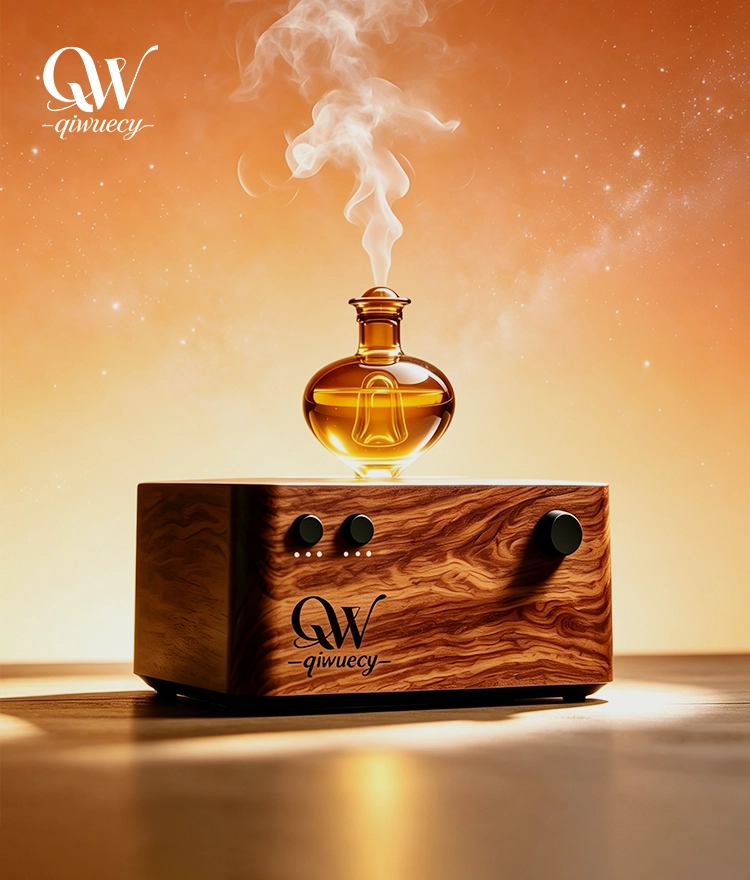
Borosilicate glass and natural wood are often combined in premium diffuser construction to balance material stability with visual appeal. Glass is less likely to interact with concentrated fragrance formulations than some plastics, helping preserve the intended scent profile during use. Glass construction can also support premium positioning in boutique hotels, gift collections, and lifestyle retail environments. For buyers evaluating a Glass Nebulizing Diffuser, the transparent reservoir can make oil levels easier to monitor and significantly improve product presentation in retail displays or hospitality environments.
The QW004 weighs around 500 grams, making it suitable for stable tabletop placement while still maintaining a substantial, high-quality feel. However, because the device features a natural wood base and a glass reservoir, operators should handle it with care in high-traffic commercial areas to prevent accidental drops. It is also advisable to wipe away any spilled fragrance oil promptly to protect the wood finish from long-term staining or corrosion.
Operational Efficiency for Commercial Use
Battery-powered operation can simplify placement in reception areas, retail displays, meeting rooms, or temporary event spaces where visible cables are undesirable. Timer options of approximately 2, 4, or 6 hours also allow operators to schedule scenting cycles without constant manual adjustment.
However, buyers should compare battery capacity with actual operating patterns rather than relying on capacity alone. Runtime can vary depending on atomization intensity and cycle settings. For multi-location deployments, programmable timers can help standardize operating routines and reduce unnecessary oil consumption.
Maintenance requirements are another important consideration. Water-based ultrasonic models generally require regular reservoir cleaning because water quality and mineral content can affect the device. According to Foster & Liu (2024), maintenance practices and the presence of water are relevant factors when comparing microbial risk considerations between water-based and waterless aroma diffusion systems.[4] Waterless glass systems remove the need for daily water refilling, although atomization components may still require periodic cleaning depending on the oil formulation used.
Why Glass Waterless Aroma Diffusers Are Becoming the Preferred Choice in 2026
Market Data Driving Adoption Rates
Commercial buyers are increasingly looking beyond basic fragrance output when selecting scenting equipment. Common concerns with conventional systems include inconsistent coverage in larger spaces, frequent reservoir maintenance, and visible moisture around devices.
Waterless systems address some of these operational concerns by dispersing concentrated oils directly through controlled airflow. According to Anderson & Richardson (2025), commercial applications increasingly favor scenting technologies that allow more predictable operation and easier integration into hospitality and retail environments.[1]
The trend is also connected to changing expectations for product design. Businesses no longer necessarily want scenting equipment to look like a purely functional appliance. Glass and wood designs allow the diffuser to become part of the interior environment rather than something that needs to be hidden.
Solving Critical Business Pain Points
Procurement managers often face a practical challenge: finding equipment that fits the visual identity of a space without creating additional maintenance work.
Glass and wood combinations can support interior styles commonly used in boutique retail, hospitality, wellness, and premium gifting. At the same time, waterless operation eliminates the need to manage a separate water reservoir.
For multi-site buyers, this can simplify maintenance instructions. Instead of asking staff to refill and monitor water levels every day, maintenance teams can focus on oil replacement, periodic cleaning, and performance checks.
Environmental and Safety Advantages
Waterless diffusion may also appeal to businesses seeking to reduce routine water consumption and simplify equipment maintenance. Glass components can be visually inspected for cleanliness and oil levels, while low-power operation may help reduce electricity use compared with higher-power scenting equipment.
According to Donovan (2025), sustainability assessments of commercial wellness products increasingly consider factors such as energy consumption, material selection, product lifespan, and maintenance requirements rather than focusing on a single environmental metric.[3]
For buyers, the most practical approach is to evaluate the entire operating cycle: energy use, oil consumption, replacement frequency, packaging, and expected product lifespan.

Comparing Glass Waterless Aroma Diffusers with Other Diffuser Types
Performance Metrics Across Technologies
Different diffuser technologies are designed for different priorities. Ultrasonic units are widely available and often suitable for smaller residential spaces, while reed diffusers operate passively and require no electrical components. Waterless nebulizing systems are generally selected when stronger scent concentration and programmable operation are required.
| Feature | Waterless Glass Diffuser | Ultrasonic Diffuser | Reed Diffuser |
|---|---|---|---|
| Water required | No | Yes | No |
| Fragrance source | Concentrated oil | Oil mixed with water | Passive evaporation |
| Intensity control | Usually adjustable | Usually adjustable | Limited |
| Maintenance | Periodic cleaning | Regular tank cleaning | Reed replacement |
| Suitable for larger spaces | Often suitable | Depends on the model | Usually limited |
| Visual customization | High | Moderate | Moderate |
The best choice depends on the intended environment rather than on one technology being suitable for every application. Buyers sourcing for hotels or retail spaces should test devices under actual ventilation and occupancy conditions.
Cost-Benefit Analysis for B2B Deployment
Glass Waterless Aroma Diffuser may have a higher initial purchase price than entry-level ultrasonic models, but procurement teams should consider the total cost of ownership.
Relevant cost factors include:
- Initial unit price
- Essential oil consumption
- Electricity use
- Cleaning labor
- Replacement components
- Expected product lifespan
- Product return rates
For example, a hotel operating dozens of units may find that maintenance labor becomes more important than the initial product price. Martinez & Thompson (2022) emphasize that hospitality procurement decisions increasingly consider lifecycle costs, maintenance workload, and supplier support rather than focusing exclusively on FOB pricing.[5]
Instead of assuming a fixed percentage of cost savings, buyers should request sample units and calculate operating costs based on their own deployment frequency.
Procurement Comparison Checklist
| Evaluation Factor | Questions Buyers Should Ask |
|---|---|
| Coverage | What room size was used for testing? |
| Oil consumption | What is the approximate consumption range per hour? |
| Noise | What is the operating noise level under normal conditions? |
| Battery | How does runtime change across intensity settings? |
| Cleaning | Which components require routine maintenance? |
| Materials | Are glass, seals, and oil-contact components compatible with intended oils? |
| Customization | What changes are possible without creating a new mold? |
| MOQ | What is the minimum quantity for standard and customized orders? |
| Lead time | How does production time change after customization? |
| Spare parts | Are replacement atomizers or other components available? |
Procurement Insights: Buying and Sourcing Glass Waterless Aroma Diffusers
Navigating OEM Customization Options
For gift brands and lifestyle retailers, customization can influence purchasing decisions as much as technical performance. OEM and ODM options may include logo placement, glass finishes, wood colors, packaging, and decorative treatments.
The QW004 platform can potentially support customized branding and packaging depending on order requirements. Buyers should clearly separate cosmetic customization from structural customization. Changing a logo or surface finish may require a shorter development cycle, while creating a new glass shape or internal structure can involve additional sampling and tooling.
A practical sourcing process is:
- Confirm technical specifications.
- Test a standard sample.
- Approve customization details.
- Confirm packaging requirements.
- Review pre-production samples.
- Proceed with mass production.
This process helps reduce misunderstandings between product design expectations and manufacturing feasibility.
Evaluating Manufacturing Credentials
Supplier evaluation should go beyond factory size or the number of patents displayed in marketing materials. Buyers should assess whether a manufacturer controls the components that directly influence atomization performance.
Qiwuecy reports more than 100 technical patents and production facilities covering roughly several thousand square meters. Such infrastructure can be relevant when evaluating production capacity, but buyers should still verify how these capabilities apply to the specific model being sourced.
Key supplier evaluation factors include:
| Supplier Capability | Why It Matters |
|---|---|
| In-house product development | May improve technical communication |
| Atomization component expertise | Directly affects diffusion performance |
| Sample testing process | Helps identify compatibility issues |
| Customization capability | Supports private-label development |
| Production capacity | Important for repeat orders |
| Quality inspection process | Helps improve batch consistency |
| After-sales communication | Useful when handling returns or technical issues |
Vertical integration can reduce communication layers, particularly when buyers require repeated design adjustments. However, sample verification remains essential before committing to large production volumes.
Logistics Considerations for Glass Products
Glass products require more attention during packaging and freight planning than plastic devices. Buyers should ask suppliers how products are protected against vibration and impact during transportation.
Useful questions include:
-
Is the glass chamber individually protected?
-
Are internal inserts used to reduce movement?
-
Has the packaging been evaluated for common shipping conditions?
-
Are spare glass components available?
-
How are damaged units handled during bulk shipments?
The QW004 weighs around 500 grams, so freight calculations should consider both actual and volumetric weight. For larger orders, consolidated shipping may reduce the logistics cost per unit.
Packaging should also match the intended sales channel. A product positioned as a Decor glass diffuser product may require more attention to presentation packaging than a diffuser supplied for internal commercial use. Buyers should therefore evaluate both protective packaging performance and retail display requirements during supplier sampling, particularly when products will be sold directly as premium gifts.
For international shipping, confirm that the battery complies with UN38.3 and that the necessary safety documents (MSDS) are provided.

Maintenance and Safety: Ensuring Optimal Performance and Longevity
Essential Oil Selection for Optimal Performance
Oil formulation has a direct impact on waterless diffuser performance. Pure essential oils with suitable viscosity generally atomize more easily than products containing heavy carrier oils or thick additives.
Buyers planning to bundle diffusers with fragrances should test the actual oil formulations with the selected device. Chen & Martinez (2024) highlight that atomization results can vary according to oil properties and airflow conditions, which means compatibility testing is more reliable than relying only on general product descriptions.[2]
Different commercial environments may also require different scenting strategies. Retail spaces may prioritize brighter fragrance profiles, while wellness or hospitality environments may prefer softer and longer-lasting diffusion cycles.
Maintenance frequency should reflect usage intensity. A diffuser operating throughout the day may require more frequent inspection than one used for several hours only.
When sourcing for resale, buyers should request clear maintenance instructions and recommended operating cycles. This can reduce customer support questions and help distributors provide more consistent guidance.
Product lifespan also depends on oil compatibility, cleaning practices, battery usage, and atomization frequency. Rather than relying on a universal lifespan estimate, procurement teams should ask suppliers about component replacement options and warranty policies for the specific operating environment.
Conclusion
The growing interest in waterless glass aroma diffusion reflects a broader shift toward products that combine design flexibility with practical operation. Glass Waterless Aroma Diffuser systems offer an alternative to water-based devices for buyers who want concentrated fragrance delivery, reduced water handling, and a more premium visual presentation.
For procurement professionals, the key decision should not be based on coverage claims alone. Oil consumption, atomization consistency, maintenance requirements, customization flexibility, packaging protection, and supplier responsiveness all influence the long-term value of a purchase.
As commercial buyers continue to prioritize differentiated product design and manageable operating costs, glass waterless diffusion systems are likely to remain relevant across hospitality, wellness, gifting, and lifestyle retail applications.
FAQ
1. What should buyers check before placing a bulk order?
Before placing a large order, buyers should request samples and test atomization consistency, oil compatibility, operating noise, battery performance, and packaging quality. It is also useful to confirm MOQ requirements, customization costs, spare parts availability, and estimated production timelines.
2. Which essential oils are suitable for waterless diffusion technology?
Pure essential oils with suitable viscosity are generally easier to atomize. Oils containing heavy carrier oils or thick additives may require additional compatibility testing. Buyers planning to sell diffuser-and-oil bundles should test the actual formulations rather than assuming all oils will perform the same way.
3. How can procurement teams estimate the total cost of ownership?
The calculation should include more than the unit price. Buyers should estimate oil consumption, maintenance labor, electricity use, replacement components, product returns, and expected replacement cycles. Testing several units before a large deployment can provide more useful cost data than relying only on supplier estimates.
4. What customization options are usually available for B2B orders?
Depending on the supplier and order volume, customization may include logo placement, glass finishes, wood colors, packaging, and decorative details. Structural changes such as custom glass shapes may require additional development time, so buyers should confirm which options are possible within their target launch schedule.
5. How should buyers reduce shipping risks for glass diffusers?
Procurement teams should review packaging specifications before mass production and ask how glass components are protected during transportation. For large shipments, it is also worth discussing spare-unit policies and procedures for handling transit damage.

Partner with Qiwuecy for Your Glass Waterless Aroma Diffuser Needs
Qiwuecy has experience in atomization technology and provides Glass Waterless Aroma Diffuser solutions for B2B buyers seeking standard products or customized projects. The company offers manufacturing capabilities that support product development, branding, packaging customization, and bulk production.
For boutique retail collections, hospitality projects, or customized gift programs, buyers can discuss requirements such as product appearance, branding, packaging, and order volume before moving into sampling. A practical sourcing process should begin with specification confirmation and product testing, followed by customization approval and production planning.
Contact the Qiwuecy team at marketing@qiwuecy.com to discuss product specifications, sample requirements, and potential OEM or ODM cooperation.
References
1. Anderson, M. L., & Richardson, P. (2025). Advances in Commercial Aromatherapy Technologies: Waterless Diffusion Systems. Journal of Hospitality Equipment Research, 18(3), 112-128.
2. Chen, Y., & Martinez, S. (2024). Comparative Analysis of Essential Oil Atomization Methods in Retail Environments. International Journal of Fragrance Technology, 41(2), 67-85.
3. Donovan, K. R. (2025). Sustainability in Commercial Scenting: Energy Efficiency and Material Innovation. Green Building Review Quarterly, 29(1), 44-59.
4. Foster, J., & Liu, X. (2024). Microbial Risk Assessment in Water-Based versus Waterless Aroma Diffusion Systems. Environmental Health Technology, 15(4), 201-217.
5. Harrison, T. E. (2026). B2B Procurement Strategies for Hospitality Fragrance Solutions. Commercial Interior Design Management, 33(1), 88-104.
6. Williams, G. P., & Thompson, A. (2025). Glass Material Science in Modern Aromatherapy Devices: Durability and Aesthetic Performance. Materials Engineering for Consumer Products, 22(2), 156-172.
This article is published by Qiwuecy and includes references to Qiwuecy products. Product specifications and certification status should be confirmed with the supplier for the exact model and production configuration.
Online Message