Sep 3, 2026
Why Choose a Glass Waterless Fragrance Diffuser for Your Home?
Choosing a Glass Waterless Fragrance Diffuser can give homeowners and B2B buyers a more concentrated way to disperse fragrance while avoiding the need to manage a water reservoir. Compared with water-based ultrasonic models, waterless systems generally use cold-air nebulization to disperse fragrance without adding water, while glass construction provides a premium appearance and allows users to monitor the remaining oil. The actual scent coverage, oil consumption, and maintenance requirements still depend on the atomization system, fragrance formulation, room size, and operating conditions. For buyers comparing premium diffuser options, this guide explains the technology, glass material, performance factors, customization possibilities, maintenance requirements, and supplier evaluation points so you can make a more informed purchasing decision.
Understanding Glass Waterless Fragrance Diffusers
What Sets Waterless Technology Apart
A key difference lies in how the scent is released. Traditional ultrasonic diffusers create an aerosol using vibrations and blend the water and fragrance oil. Most waterless systems employ a pressure differential and air flow to draw the fragrance into an air stream and to atomize the liquid into small droplets.
No heat is required for this, nor a water reservoir. Buyers should not expect a single constant particle size, but should understand that droplet distribution is dependent on nozzle design, air flow, pressure, oil viscosity and formulation. Fine droplets can remain airborne longer but real room performance also depends on ventilation, airflow and room design.
Qiwuecy characterizes the technology of the QWSS004 as a compressed-air or Venturi style atomization device. The advertized coverage is about 1,000 square feet, although that number should be viewed more as a reference point than a universal performance value. Buyers should request the test circumstances and judge the coverage against the fragrance mixtures that they actually want to sell.
Why Glass Matters in Diffuser Design
Material selection affects appearance, oil compatibility, durability, and user experience. Glass is commonly used for fragrance containers because it provides a relatively stable contact surface and allows the remaining oil to be seen directly. High-borosilicate glass can also be useful where resistance to thermal and chemical stress is a design consideration.
According to ISO 210:2023, materials used for essential-oil packaging and containers should be considered in relation to the oil, intended use, conditioning, and storage requirements [1]. This makes material compatibility a practical purchasing issue rather than simply an aesthetic choice.
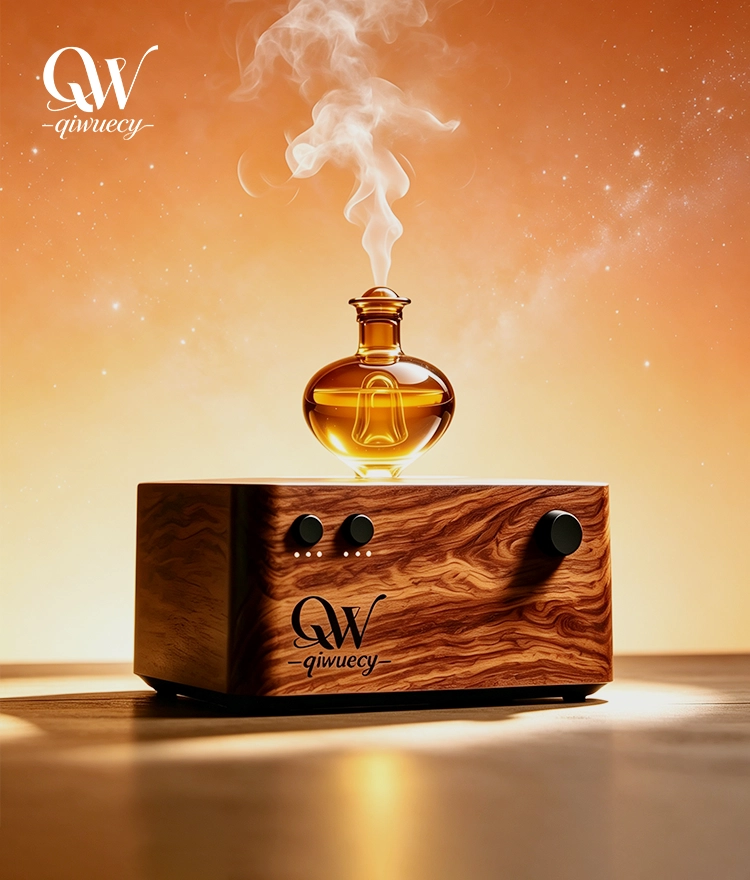
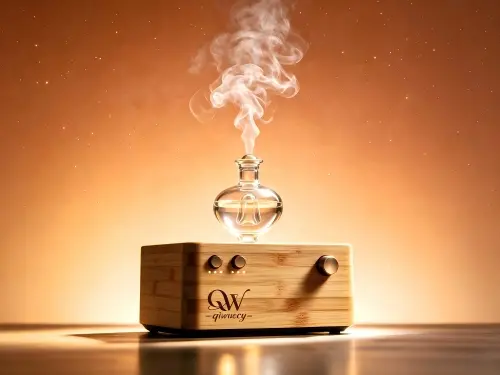
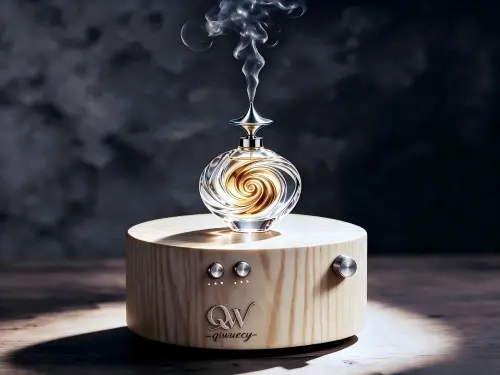
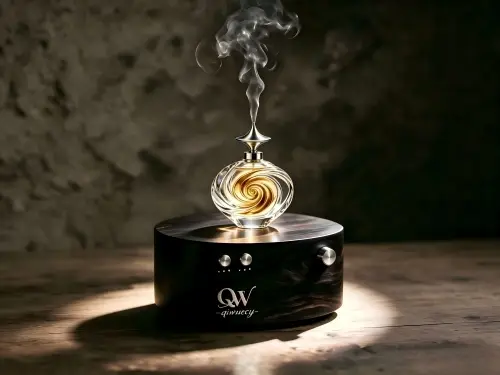
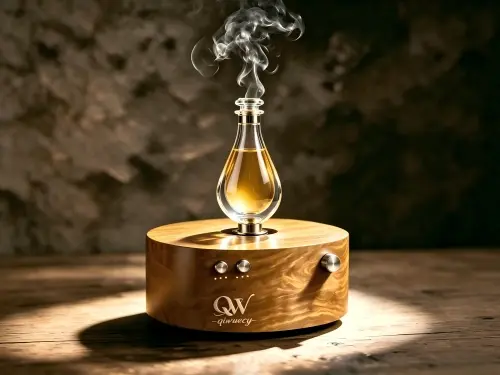
The QWSS004 combines a glass body with natural wood accents in a compact desktop format. For retail, hospitality, and home-fragrance brands, glass can also support customization through transparent, frosted, gradient, or decorated finishes. Buyers should nevertheless compare the added weight and packaging requirements of glass with the visual value it provides.
Technical Advantages for Commercial Applications
Waterless systems can simplify some operating tasks because there is no standing water reservoir to refill or manage. This can be useful in hotels, retail stores, offices, reception areas, and other environments where multiple units are serviced.
The QWSS004 is described by the supplier as a rechargeable, low-power model with several timer settings. Its battery capacity is around 2,000 mAh, while its rated power consumption is around 2 W. These figures can help buyers estimate operating requirements, but actual battery life depends on intensity, operating cycles, battery condition, and usage patterns.
Waterless operation should not automatically be interpreted as better indoor-air performance. Research by Angulo-Milhem, Verriele, Nicolas & Thevenet (2021) found that essential-oil diffusion can contribute to terpene VOC emissions and that exposure characteristics vary according to diffusion conditions and duration [2]. Therefore, commercial buyers should evaluate fragrance intensity, ventilation, application environment, and operating schedules together.
Comparing Glass Waterless Diffusers with Other Types
Glass Versus Ceramic Nebulizers
Glass and ceramic can both support premium diffuser designs, but they create different procurement considerations. Glass makes the oil reservoir visible and can support transparent or gradient effects. Ceramic is generally opaque and can provide textured or handcrafted finishes.
For larger orders, buyers should compare material weight, packaging requirements, breakage risk, customization methods, and freight costs instead of selecting purely on appearance.
| Factor | Glass Waterless Diffuser | Ceramic Nebulizer |
|---|---|---|
| Oil visibility | Usually visible | Usually opaque |
| Appearance | Transparent, frosted, gradient | Textured, glazed, opaque |
| Customization | Color, coating, decoration | Shape, glaze, texture |
| Shipping | Requires protective packaging | Requires protective packaging |
| Weight | Depends on glass thickness | Depends on ceramic construction |
| Typical positioning | Premium home and commercial products | Decorative and artisanal products |
For OEM projects, request physical samples before approving production. This is especially important for custom glass colors, surface treatments, and new shapes because appearance can vary between digital designs and finished products.
Waterless Systems Versus Ultrasonic Models
Ultrasonic Premium Glass Diffusers remain popular because water-based designs are familiar and can be economical. Their main operational difference is that they mix fragrance with water, while waterless nebulizers disperse fragrance without a water reservoir.
| Procurement Factor | Waterless | Ultrasonic |
|---|---|---|
| Water required | No | Yes |
| Fragrance dilution | Generally none | Mixed with water |
| Added moisture | Minimal from the device | Yes |
| Reservoir maintenance | Oil residue still requires cleaning | Water reservoir requires regular cleaning |
| Fragrance concentration at source | Higher | Lower because of water dilution |
| Battery options | Common in portable models | Depends on model |
| Best fit | Concentrated fragrance applications | General home and decorative use |
According to Schwartz-Narbonne, Du & Siegel (2021), ultrasonic essential-oil diffusers can produce VOC and particulate emissions, with measured emissions influenced by the oil and water used [3]. This does not mean every ultrasonic or waterless device behaves identically, but it reinforces the value of testing the actual product and operating conditions before making a large procurement decision.
Environmental and Safety Considerations
Waterless operation reduces the need for water consumption within the diffuser itself and removes the need to manage water in a reservoir. However, it does not eliminate all environmental or operational considerations.
Essential Oils and fragrance formulations release volatile compounds into indoor air. According to Angulo-Milhem et al. (2021), emission rates and exposure characteristics should be considered when evaluating indoor essential-oil diffusion [2]. Buyers should therefore match diffuser output to room size, ventilation, operating schedule, and intended use.
For electrical and battery-powered products, procurement teams should also identify the documentation and market requirements applicable to the destination country and specific product configuration rather than assuming that one set of documents covers every market.
Selecting the Best Glass Waterless Diffuser for Your Needs
Evaluating Coverage Area and Capacity
Room size should be one of the first selection criteria. The QWSS004 is marketed for coverage of roughly 1,000 square feet, but actual performance may change with ceiling height, ventilation, room layout, fragrance formulation, and desired scent intensity.
Ask suppliers to provide the test conditions behind their coverage claims. A useful product specification should include approximate coverage, fragrance consumption, operating modes, battery capacity, timer functions, and recommended fragrance types.
For B2B buyers managing several locations, standardizing on one or two models can simplify spare parts, staff training, packaging, and inventory management. A portable battery-powered design can also be useful for exhibitions, temporary displays, reception desks, and other locations where fixed power is inconvenient.
Essential Oil Compatibility and Performance
Waterless nebulizers do not necessarily perform identically with every fragrance. Viscosity, additives, carriers, and resin content can affect liquid flow and atomization.
Light citrus oils and thicker formulations such as resin-rich blends may require different operating conditions. Synthetic fragrance oils containing thickeners or other additives may also leave more residue in the atomization path.
Before placing a bulk order, ask the supplier to test the actual formulations used in your product range. Instead of relying on a general statement that the device is compatible with “all oils,” request information about recommended viscosity, approximate consumption, cleaning procedures, and output consistency.
Customization Potential for Brand Identity
OEM/ODM capability gives brands more control over product appearance and packaging. Qiwuecy describes customization options including logos, transparent or frosted glass, gradient finishes, surface decoration, and branded packaging.
For smaller launches, a standard glass body with customized branding may be more practical. Larger programs may justify custom glass shapes, specialized finishes, or new molds. Each additional customization can affect tooling, sample approval, production time, minimum order quantity, and freight costs.
Research by Carnevale, Hadi, Luna & Pogacar (2023) found that consumer responses to product scents can be influenced by the relationship between scent-related cues and brand-product congruence [4]. For fragrance brands, this supports considering the diffuser's appearance, packaging, and scent positioning as one product experience rather than treating hardware design separately.
Maintenance, Safety, and Longevity
Routine Care Procedures
Waterless systems generally reduce water-related maintenance, but they are not maintenance-free. Essential-oil residue can accumulate around the reservoir, nozzle, or atomization path, particularly when thicker formulations are used.
The appropriate cleaning interval depends on the oil and operating frequency. The original QWSS004 guidance recommends cleaning with isopropyl alcohol after a period of use, but buyers should follow the current manufacturer's instructions rather than applying one fixed interval to every formulation.
For commercial fleets, a practical maintenance checklist should include:
Reservoir inspection and cleaning
Nozzle and atomization-path inspection
Battery charging and storage
Output consistency checks
Seal and connection inspection
Cleaning before changing between strongly different fragrance formulations
This approach helps procurement teams estimate the real maintenance workload instead of assuming that waterless operation requires no servicing.
Safety Certifications and Compliance
Certification and documentation requirements vary by destination market, electrical configuration, battery type, and sales channel. Buyers should request the current technical documents applicable to the finished product and intended market.
For rechargeable models, documentation related to the battery, electrical system, labeling, and transportation may need separate review. Rather than listing general certifications as proof of suitability, procurement teams should verify the actual reports and declarations supplied for the specific model.
For the QWSS004 glass cold mist fragrance diffuser, buyers should confirm the current documentation package, warranty terms, battery information, and applicable market requirements directly with the manufacturer before ordering.
| Parameter | Details |
|---|---|
| Model | QWSS004 |
| Product Size | 150×150×168mm |
| Weight | Approx. 500g (excluding packaging and oil) |
| Material | Glass + Wood |
| Rated Voltage | DC 5V / 1A |
| Power Consumption | 2W |
| Working Mode | Home |
| Spraying Method | Compressed Air System (Venturi System) |
| Timer Function | 2H / 4H / 6H |
| Ambient Light | 2 Colors |
| Battery Capacity | 2000mAh |
| Coverage Area | Up to 1,000 sq.ft. |
| Warranty | 2 Years |
Factors Affecting Device Lifespan
Service life depends on operating frequency, fragrance viscosity, cleaning practices, battery usage, pump performance, seals, and physical handling.
Glass can provide a stable reservoir material, but it can still be damaged by impact or improper handling. Packaging quality therefore matters as much as material selection when products are shipped internationally.
For rechargeable models, avoid treating a single battery cycle-life figure as a guaranteed service period. Battery performance changes according to charging conditions, operating temperature, usage frequency, and storage. For hotel or retail networks, spare-part availability, warranty terms, repair procedures, and replacement costs are often more useful procurement indicators.
Procurement and Sourcing Guide for B2B Clients
Identifying Qualified Manufacturers
A supplier should be assessed on more than product specifications. Manufacturing capacity, engineering support, quality control, customization, documentation, and after-sales service all affect the total procurement risk.
According to information provided by Qiwuecy, the company operates dedicated production facilities and automated equipment for atomization-core manufacturing and reports more than a hundred technical patents. These figures should be treated as supplier-provided information and verified through factory audits, documentation, samples, and production records before they are used as purchasing criteria.
| Evaluation Area | What Buyers Should Verify |
|---|---|
| Product quality | Sample consistency and inspection records |
| Atomization | Output stability and oil consumption |
| Materials | Glass type and oil-contact materials |
| OEM capability | Logo, color, mold, and packaging options |
| Production | Capacity and batch consistency |
| Documentation | Applicable technical and market documents |
| Service | Warranty, spare parts, and technical support |
| Logistics | Protective packaging and export experience |
Customization Workflows and Timelines
Standard products generally move faster than custom OEM projects. Stock products may be available within roughly one to two weeks, while custom samples can require several additional weeks depending on mold development, glass treatment, packaging, and technical changes.
Mass production can require several more weeks after sample approval. Before placing an order, confirm four milestones:
Final technical specification
Approved production sample
Packaging and artwork approval
Mass-production inspection
Custom glass shapes and specialized finishes can add development time, so buyers should build a development buffer into seasonal or promotional product schedules.
Logistics Considerations and Quality Assurance
Glass requires protective packaging during international transportation. Buyers should ask whether suppliers use foam inserts, molded pulp, dividers, reinforced cartons, or other suitable protection.
Freight cost should be calculated from both product weight and packed carton dimensions. Instead of looking only at the factory unit price, compare packed weight, carton quantity, shipping volume, and estimated breakage exposure.
Quality inspection should cover glass appearance, surface finish, assembly, atomization output, battery operation, controls, packaging, and labeling. For larger orders, a pre-shipment inspection and retained reference sample can provide a clearer basis for resolving quality differences between the approved sample and mass production.
Conclusion
The purchase of a Glass Waterless Fragrance Diffuser combines fragrance technology with a premium material and design format. Its main technical distinction is waterless atomization, which can deliver concentrated fragrance without adding water to the diffusion process. Glass can further support product visibility, visual differentiation, and OEM customization.
For homeowners and B2B buyers, however, the right choice should not be based on appearance alone. Coverage, oil compatibility, consumption, maintenance, battery performance, packaging, customization requirements, documentation, and total logistics cost all deserve evaluation.
The most practical purchasing approach is to test representative fragrances, compare waterless and ultrasonic models under similar conditions, verify supplier documentation, and approve production samples before committing to larger volumes.
FAQ
1. How does waterless diffusion compare to traditional methods?
Waterless diffusion disperses concentrated fragrance without mixing it with water, while ultrasonic systems use water and vibration to create an aerosol. The two technologies therefore differ in fragrance concentration, moisture output, maintenance, and operating conditions. For procurement decisions, compare actual fragrance consumption and room performance rather than assuming that one technology will always produce stronger results.
2. What maintenance do glass nebulizers require?
Glass nebulizers still require periodic cleaning because essential oils can leave residue in the reservoir and atomization path. The appropriate interval depends on fragrance viscosity, formulation, and operating frequency. For B2B purchasing, ask suppliers for a written cleaning procedure and determine whether nozzles, seals, and other serviceable parts can be replaced.
3. Can the device handle all essential oil types?
Not necessarily. Oil viscosity, additives, carriers, and resin content can influence atomization. Buyers should test representative light and heavy formulations before bulk purchasing and request the supplier's recommended oil-compatibility range.
4. Is the glass component durable during operation?
Glass can work well as a fragrance reservoir, but its practical durability depends on glass type, wall design, assembly, handling, and packaging. Buyers should evaluate impact protection and shipping packaging alongside the glass specification, especially for international distribution.
5. What should buyers verify before placing a bulk order?
Ask for a production sample, technical specification, approximate oil consumption, coverage test conditions, cleaning instructions, warranty terms, spare-part availability, packaging details, and applicable market documentation. For OEM projects, also confirm MOQ, tooling costs, sample approval procedures, and estimated production lead time.
Partner with Qiwuecy for Premium Scenting Solutions
Qiwuecy focuses on waterless fragrance and atomization products and describes its experience as spanning more than a decade. The company reports an integrated manufacturing setup covering product development, molding, assembly, and atomization-core production.
For B2B buyers, the more important question is whether a supplier can support the complete purchasing process—from sample development and glass customization to quality inspection, documentation, packaging, and shipment coordination.
Qiwuecy describes customization options including glass finishes, surface treatments, logo application, and branded packaging. Buyers can start with a standard model to evaluate fragrance performance before moving into more complex OEM development.
As a Glass Waterless Fragrance Diffuser manufacturer, Qiwuecy supplies products for applications including home fragrance, boutique retail, hospitality, promotional gifts, and private-label collections. Buyers should confirm current MOQ, production capacity, lead time, warranty terms, and technical documentation directly with the supplier before placing an order. Get in touch with marketing@qiwuecy.com to talk about your unique needs and find out how our technical skills can help you improve your fragrances.
References
1. International Organization for Standardization. (2023). ISO 210:2023 — Essential oils — General requirements and guidelines for packaging, conditioning and storage.
2. Angulo-Milhem, S., Verriele, M., Nicolas, M., & Thevenet, F. (2021). Indoor use of essential oils: Emission rates, exposure time and impact on air quality. Atmospheric Environment, 244, 117863.
3. Schwartz-Narbonne, H., Du, B., & Siegel, J. A. (2021). Volatile organic compound and particulate matter emissions from an ultrasonic essential oil diffuser. Indoor Air, 31, 1982–1992.
4. Carnevale, M., Hadi, R., Luna, D., & Pogacar, R. (2023). Follow your nose when it sounds right: How brand names influence consumer responses to product scents. Journal of Business Research, 157, 113578.
Online Message