Sep 8, 2026
What Are the Application Fields of Atomizing Cores | Four Atomization Technologies Including Venturi Two‑Fluid
Atomizing cores are the critical core components of all atomizing devices, widely known as the “heart” of atomization equipment. Using principles including microporous penetration, thermal vaporization, ultrasonic vibration, and Venturi two‑fluid shearing, these components convert liquid materials into micron‑sized aerosol droplets. Most people associate atomizing cores only with vaping products. However, advances in ceramic, composite silicon nitride, and Venturi two‑fluid technologies have expanded atomizing cores far beyond a single industry. They are now widely adopted across high‑value sectors: consumer electronics, medical healthcare, home & personal care, and industrial special‑purpose applications.
Different downstream industries impose distinct requirements on atomizing cores in terms of particle size, corrosion resistance, biocompatibility, service life, power consumption, and compliance certification. For equipment developers, procurement specialists, and ODM/OEM clients, understanding technical solutions, application requirements, market status, and industry pain points for atomizing cores helps identify the ideal atomization solution for new projects. This article breaks down the four major application fields of atomizing cores alongside four mainstream atomization technologies (with a detailed focus on Venturi two‑fluid atomization). It covers scenario‑specific selection criteria, industry trends, and frequently asked questions for R&D and purchasing teams.
Four Core Atomization Technology Solutions
Currently, the industry relies on four primary atomization technologies: thermal atomization, high‑frequency ultrasonic atomization, microporous physical atomization, and Venturi two‑fluid atomization. The first three are mature traditional solutions. Venturi two‑fluid atomization is a breakthrough technology developed in recent years for premium fragrance and commercial scenting systems. Boasting water‑free and heat‑free operation that preserves the molecular integrity of raw liquids, it has become the preferred core solution for high‑end aroma Diffusers.
1. Thermal Atomization Technology (Cotton / Ceramic Cores)
Thermal atomization works by heating a heating element to vaporize liquid that saturates the wicking material. This technology is mainly deployed in consumer vaping devices, including cotton cores, solid ceramic cores, and composite hybrid atomizing cores. It delivers stable vapor volume and supports mass production. However, it relies on high‑temperature heating and only suits dedicated e‑liquids. It cannot handle corrosive fluids such as Essential Oils or disinfectants, with risks of burnt wick and thermal degradation of liquid formulas.
2. High‑Frequency Ultrasonic Atomization Technology
This method uses piezoelectric ceramics vibrating at high frequency to shatter liquid into fine droplets. It is widely used in household humidifiers and basic aroma diffusers. It provides large mist output at a low cost. The downsides are its requirement for diluted water mixtures, high risks of mold growth, relatively large droplet sizes ranging from 8‑15 μm, weak fragrance intensity, limescale clogging over time, and frequent maintenance.
3. Microporous Physical Atomization Technology
Nanometer‑scale microporous ceramic structures produce ambient‑temperature atomization under pressure. This compact, low‑noise, low‑power solution is used for portable facial mist sprays, compact desktop humidifiers, and mini car diffusers. While it creates fine mist for lightweight portable devices, the tiny pores clog easily with viscous essential oils. It is only compatible with low‑viscosity clean liquids.
4. Venturi Two‑Fluid Atomization Technology (Premium Solution for Aroma Diffusers)
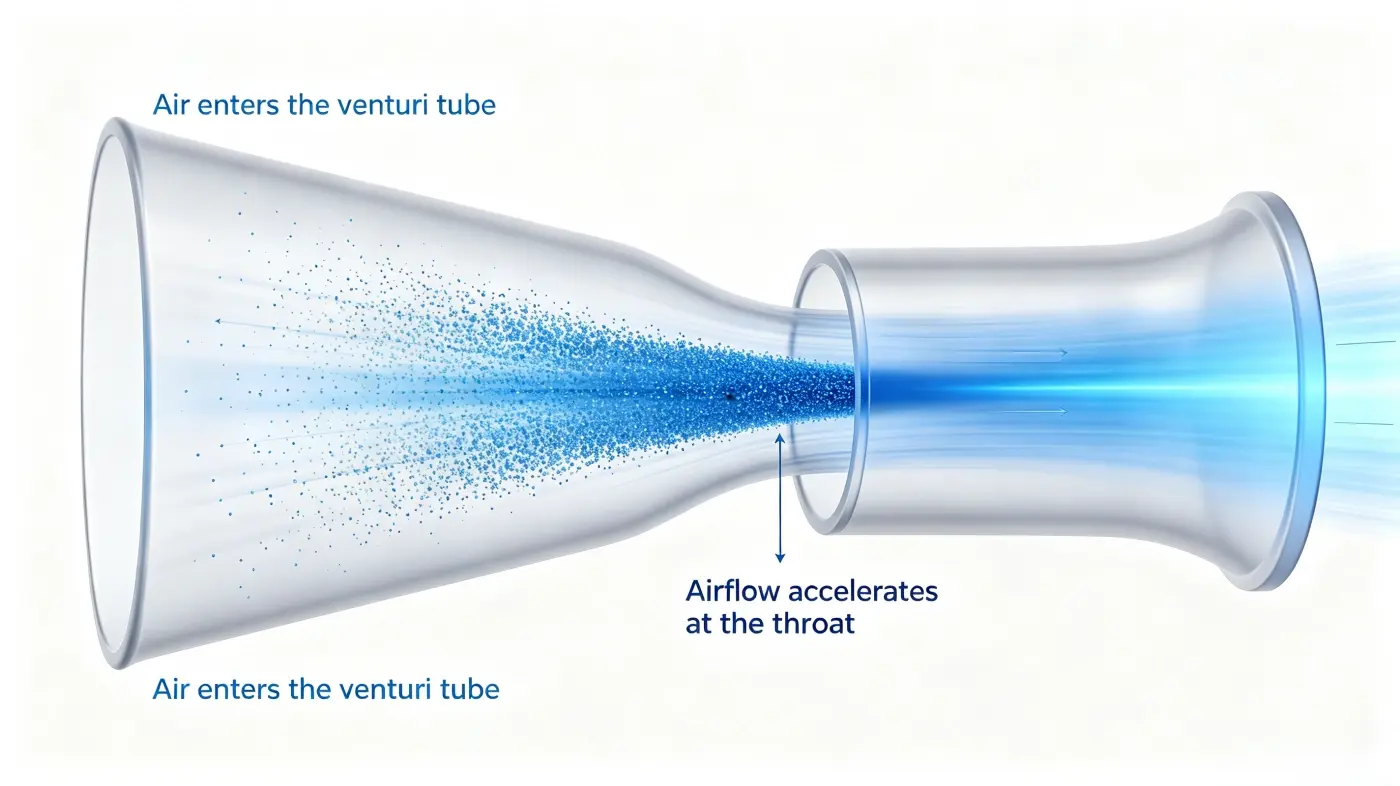
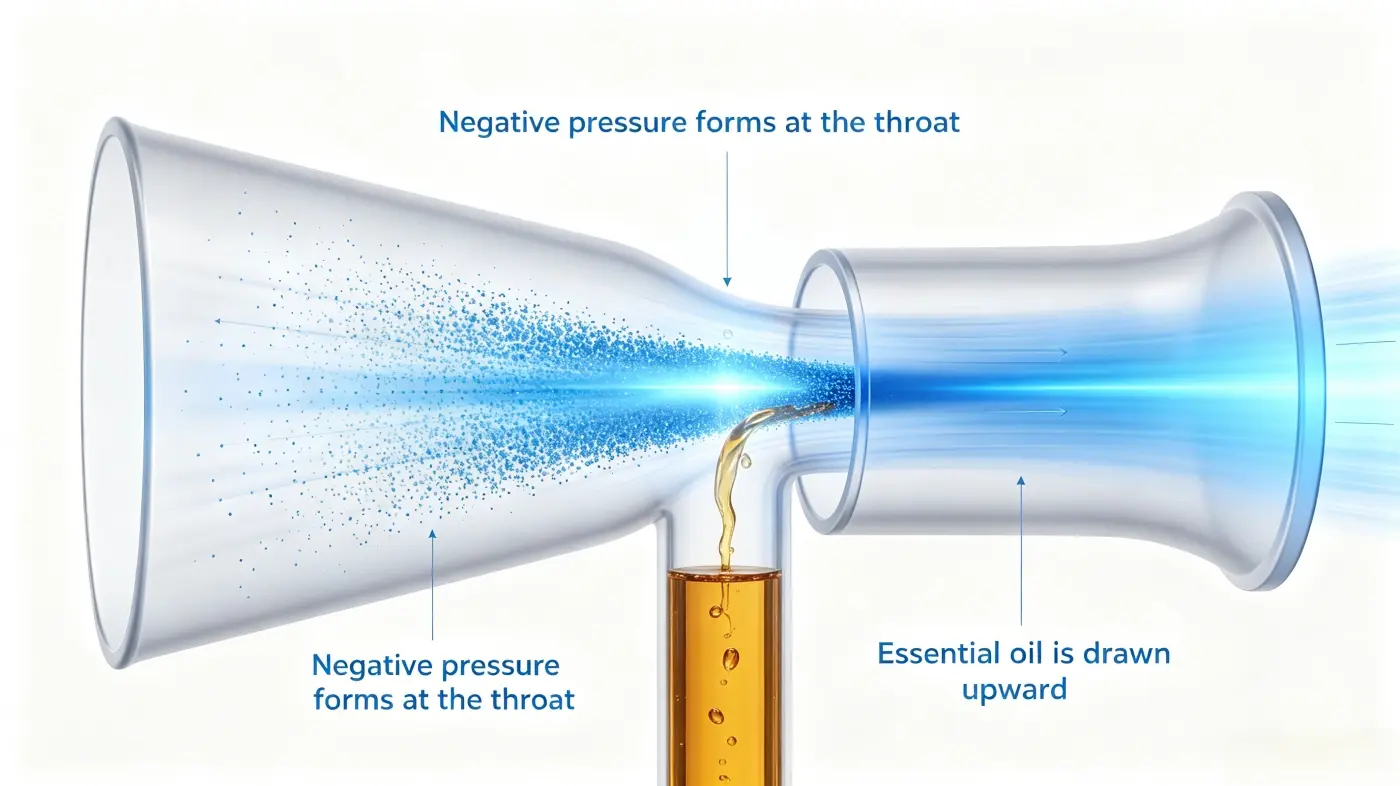
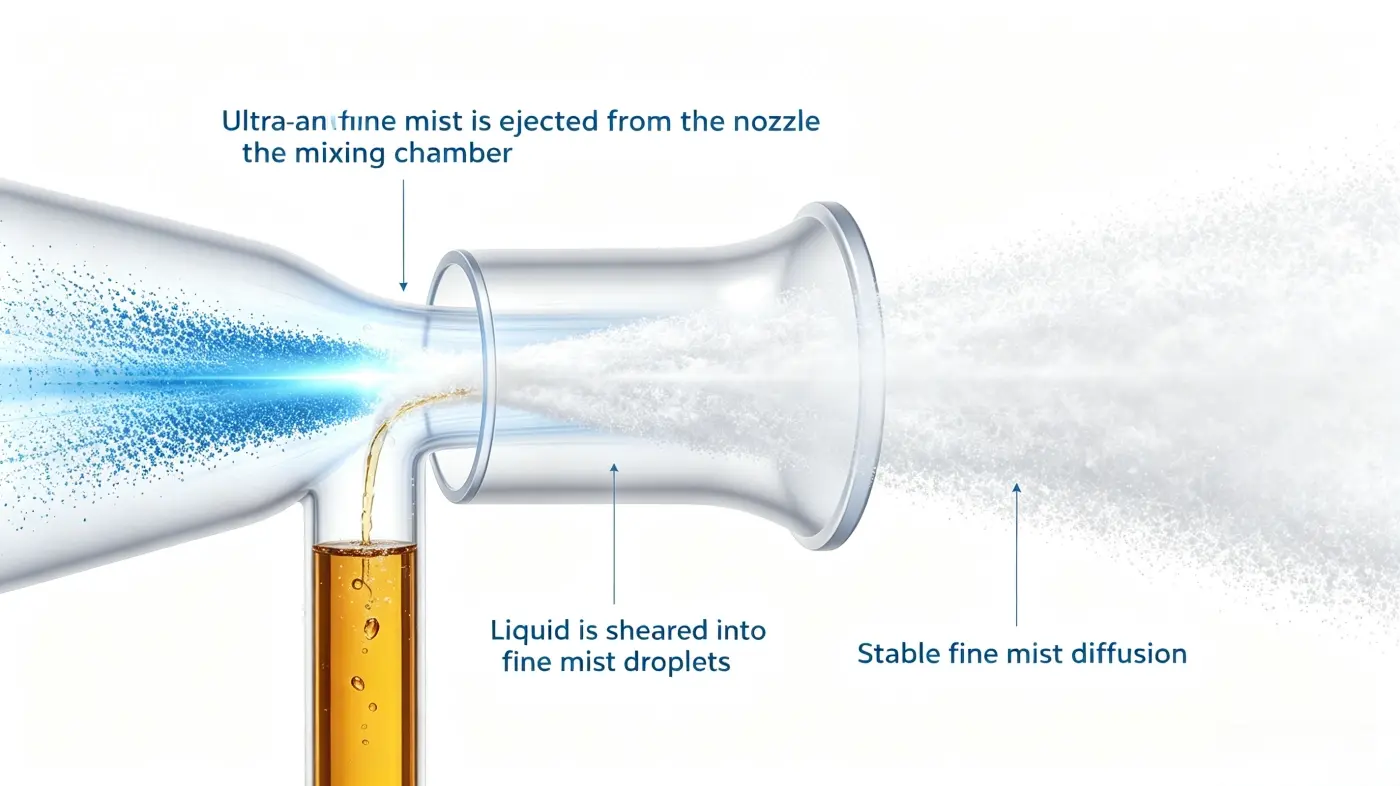
Venturi two‑fluid atomization represents the cutting‑edge core technology for waterless aroma diffusers and commercial space scenting equipment. Completely different from heating, ultrasonic or microporous principles, it operates purely at room temperature based on the Venturi effect and gas‑liquid two‑fluid shearing. High‑speed compressed air flows through a custom Venturi nozzle to instantly generate a negative‑pressure vacuum zone. Pure essential oil or fragrance liquid is automatically extracted. Powerful shearing force from the high‑velocity airflow breaks the raw liquid into ultra‑fine dry mist particles of 3‑5 μm. The whole process requires no water and no heating, with no vibrating mechanical parts.
This technology solves long‑standing pain points of traditional aroma diffusers and stands as the optimal choice for premium home fragrance, central air‑conditioning commercial scenting, and high‑end car fragrance systems. Its key advantages are listed below:
-
100% retention of active ingredients: Pure physical ambient‑temperature atomization prevents thermal degradation. The aromatic molecules of essential oils remain intact to deliver authentic, rich scent without off‑flavors or uneven volatilization.
-
Water‑free & sterile with zero contamination: No water dilution eliminates mold and limescale build‑up entirely. It does not raise ambient humidity, protecting wooden furniture, leather upholstery, and precision electronics.
-
Superior anti‑clog performance and longer service life: Free of ultra‑fine micropores or vibrating wafers, the wide fluid channels tolerate high‑viscosity natural essential oils and complex blended fragrances, overcoming the common clogging issues of microporous atomizing cores.
-
Strong diffusion for wider coverage: Ultra‑fine dry mist particles suspend stably in the air. The mist can spread throughout buildings via central air‑conditioning or fresh‑air ducts. Its diffusion efficiency is improved by 40% compared with ultrasonic atomization for large‑scale commercial environments.
-
Low‑noise stable operation with intelligent adjustable scent intensity: It runs quietly at only 28‑30 dB without high‑frequency vibration noise. Equipped with closed‑loop air‑pressure control, fragrance concentration can be precisely adjusted with a fast response time ≤ 0.8 seconds for smart home linkage.
Today, Venturi two‑fluid atomization has become the technical benchmark for high‑end waterless aroma diffusers. It is widely adopted in home waterless aroma diffusers, luxury car scent systems, hotel commercial scent diffusers, and intelligent commercial fragrance projects, gradually replacing conventional ultrasonic and microporous atomization solutions.
Consumer Electronics: The Largest Mature Market for Atomizing Cores
Consumer electronics is the earliest and highest‑volume application market for atomizing cores, accounting for roughly 75% of global atomizing core production capacity. Disposable and pod‑style vaping devices dominate this segment, mainly adopting heated ceramic and hybrid atomizing cores. Venturi two‑fluid atomization is not suitable for this category.
Mainstream Atomizing Core Solutions and Their Pros & Cons
Three major designs prevail in this sector: traditional cotton cores, ceramic atomizing cores, and hybrid composite atomizing cores.
-
Cotton cores: Fast oil delivery with satisfying initial flavor performance. Drawbacks include localized overheating, burnt taste risk, and limited service life.
-
Ceramic atomizing cores: Uniform heating, strong dry‑burn resistance, and reliable biocompatibility with outstanding safety compliance. Some basic ceramic cores deliver subpar flavor reproduction. In 2024, the market penetration rate of ceramic atomizing cores in China reached 62.3%. High‑end nano‑microporous ceramic atomizing cores can be priced at 2.3 times the cost of standard products, serving as a key differentiator for premium brands.
-
Hybrid composite atomizing cores: Built on a ceramic substrate with oil‑wicking cotton layers and full‑coverage heating elements with precise temperature control. This design eliminates weaknesses of single‑material structures, balancing oil delivery efficiency, even heating, and authentic flavor, making it the mainstream solution for premium new releases.
Mandatory Compliance Requirements for Sourcing
Global regulatory standards continue to tighten. Revisions to the EU TPD and US FDA requirements impose stricter limits on heavy‑metal leaching and biocompatibility testing. Low‑end metal heating atomizing cores are phased out due to heavy‑metal precipitation risks. For overseas exports, atomizing cores must pass material testing to meet RoHS and REACH regulations. Brand manufacturers must balance five critical factors: consistent flavor, leak‑proof design, anti‑burn performance, cost control, and regulatory compliance.
Medical Healthcare: The Fastest‑Growing High‑Barrier Market
Medical atomization is the fastest‑growing high‑potential sector for atomizing cores, holding a 14.3% market share in 2024. Industry forecasts predict its proportion will exceed 20% by 2030. Unlike consumer electronics, medical‑grade atomization prioritizes precise particle sizing, biological safety, and liquid compatibility. Manufacturing standards and certification barriers are extremely strict. High‑precision microporous ceramic atomization dominates this field. Modified Venturi two‑fluid atomization is only applied in premium wellness and nutritional inhalation devices.
Key Application Scenarios
-
Respiratory therapy nebulizers: For asthma, COPD and other lung conditions, atomizing cores must deliver strictly sized droplets to ensure accurate drug deposition in the airway and lungs. Pediatric asthma treatments require particles sized 2.5‑3.4 μm to maximize lung drug deposition. High‑quality medical atomizing cores can boost pulmonary delivery efficiency by 4.6‑6 times compared with standard consumer‑grade alternatives.
-
Nutritional pulmonary delivery devices: Class II medical devices that deliver nutritional ingredients through lung absorption for higher bioavailability than oral intake. Selected premium wellness devices adopt modified Venturi two‑fluid atomization for loss‑free nebulization of nutrient concentrates.
-
Lab aerosol generation for pharmaceutical R&D: Inhalation formulation testing requires highly stable droplet sizes and consistent batch‑to‑batch performance.
Strict Selection Criteria for Medical‑Grade Atomizing Cores
Manufacturers adopt wax‑free sintered ceramic processes to reduce impurity particles. Precious‑metal corrosion‑resistant heating materials are required. Export products must pass FDA 510(k) or CE‑MDR medical certifications, while domestic Chinese products must comply with Class II medical component standards. Standard consumer‑grade atomizing cores cannot be repurposed for clinical use due to unacceptable material leaching and inconsistent pore tolerances.
Home & Personal Care: Full‑Spectrum Atomization Technologies with Clear Segmentation in the Fragrance Industry
The home‑care market features the widest range of atomization technologies, including high‑frequency piezoelectric, microporous, and Venturi two‑fluid systems. End products cover humidifiers, beauty mist devices, car diffusers, home waterless aroma diffusers, and commercial scenting machines. Venturi two‑fluid atomization marks a clear technical dividing line for premium fragrance products.
High‑Frequency Piezoelectric Atomizers (Traditional Humidification)
Designed for high‑output large‑capacity humidifiers for residential and commercial spaces. It delivers massive mist output with fast diffusion but operates at higher noise levels and requires water refills with mold risks. This technology is only suitable for pure‑water humidification rather than essential‑oil diffusion. It is commonly used in living rooms, exhibition halls, and large offices.
Microporous Atomizing Cores (Mainstream for Compact Portable Devices)
Compact, quiet microporous cores power mini desktop humidifiers, portable beauty sprays, and tiny car diffusers. Low power consumption supports battery‑powered portable designs. However, viscous essential oils easily block the micro‑holes, limiting its suitability to low‑viscosity liquids only. It represents an entry‑level fragrance‑diffusion option.
Venturi Two‑Fluid Atomizing Cores (Exclusive for Premium Home & Car Fragrance)
Custom‑built for luxury home aroma diffusers and high‑end car scent systems, Venturi two‑fluid technology eliminates nearly all drawbacks of traditional aroma equipment. For residential use, these diffusers fit bedrooms and study rooms within smart home fragrance ecosystems. Low‑noise operation does not disrupt sleep, while pure‑essential‑oil mist delivers a long‑lasting natural scent. For automotive applications, there is no standing water or leakage risk. Dry mist will never damage car leather, interior trim, or vehicle electronics within bumpy, confined cabins. It effectively removes interior odors and relieves driver fatigue during long journeys.
Compared with ultrasonic and microporous fragrance machines, Venturi‑based diffusers require minimal maintenance. Users only top‑up essential oils instead of refilling water daily, supporting long‑term continuous operation. This has become the core upgrade trend for modern home fragrance appliances.
Industrial and Special‑Purpose Segments: Expanding Innovation Boundaries
Atomizing‑core technology extends far beyond consumer and medical markets. Industrial hygiene and special‑purpose equipment deploy customized atomization solutions for fragmented use cases. Different applications select high‑frequency, microporous, or Venturi two‑fluid atomization accordingly.
Industrial Applications
High‑frequency atomizing cores regulate humidity precisely in constant‑temperature and constant‑humidity test chambers. Fine‑spray industrial processing relies on atomization components for liquid pretreatment. Public‑sanitation disinfection systems deploy silicon‑nitride nano‑microporous atomizing cores to convert disinfectants into ultra‑fine mist for full‑space sterilization in office buildings and transit hubs.
Special Consumer‑Oriented Scenarios
Premium factory‑fitted car fragrance systems upgrade to Venturi two‑fluid atomization for uniform cabin scent distribution. Microporous atomization enables skincare‑essence nebulization for beauty devices. Novelty spray toys adopt compact microporous atomizing cores. Portable field disinfection gear and specialty enclosed‑space air‑purification fragrance systems also adopt customized Venturi and microporous atomizing‑core designs.
Industry Development Trends for Atomizing Cores
1. Material Upgrades: Ceramic and Composite Cores Replace Traditional Metal Designs
Metal‑based heating atomizing cores lose market share because of heavy‑metal‑leaching risks. Ceramic and composite hybrid atomizing cores gain traction across consumer, home, and medical markets thanks to superior safety and stability. Advanced silicon‑nitride ceramic materials are rapidly deployed for disinfection and highly corrosive‑liquid applications.
2. Clear Technology Stratification — Venturi Two‑Fluid Atomization Dominates the Premium Fragrance Segment
Distinct market segmentation emerges across technologies: basic household humidifiers use ultrasonic atomization; compact portable devices use microporous atomization; vaping hardware uses ceramic‑hybrid thermal atomization. Meanwhile, premium home diffusers, luxury car scenting, and commercial space fragrance systems are rapidly upgrading to Venturi two‑fluid atomization, creating a critical technical barrier for high‑end differentiated products.
3. Diversified Market Structure Reduces Reliance on a Single Industry
The atomizing‑core market no longer depends solely on the vaping sector. Medical atomization, premium fragrance diffusion, and industrial disinfection applications show rapid growth. More upstream manufacturers develop cross‑industry customization services for adjustable pore sizes, air‑pressure parameters, and mechanical structures to satisfy fragmented OEM orders for medical, fragrance, and industrial clients.
4. Compliance and Precision Customization Become Core Competitive Advantages
Overseas buyers demand complete component‑level certification documentation, including material reports, regulatory test certificates, and biocompatibility records. Rising demand for differentiated end products drives custom development of Venturi nozzle geometry, ceramic‑core pore specifications, and heating resistance. Flexible production lines support both large‑volume mass production and small‑batch custom orders.
Frequently Asked Questions (FAQ — Optimized for Google Featured Snippets & Long‑Tail Keywords)
Q1: What is the core difference between Venturi two‑fluid atomizing cores and traditional ultrasonic / microporous atomizing cores?
A: The differences lie in atomization principles and applicable scenarios. Ultrasonic atomization requires water dilution and carries mold‑growth risks. Microporous atomization depends on micro‑hole penetration with frequent clogging and limited liquid compatibility. Venturi two‑fluid atomization generates dry mist via pure physical gas‑liquid shearing at room temperature. It requires no water or heating, resists clogging, preserves original essential‑oil molecules, and delivers stronger long‑range diffusion. It is currently the best technical option for premium aroma diffusers, though the hardware cost is higher than traditional alternatives.
Q2: Can atomizing cores designed for different fields be interchangeably used?
A: Interchangeable use is not recommended. Consumer‑grade thermal atomizing cores cannot meet medical biocompatibility standards. Household microporous cores lack resistance against corrosive disinfectant liquids. Venturi two‑fluid atomizing cores are optimized for fragrance diffusion and are not suitable for pharmaceutical nebulization or high‑capacity industrial humidification. Every application requires a dedicated validated atomization solution.
Q3: Are ceramic atomizing cores always superior to cotton wick cores?
A: There is no absolute winner — performance depends on the application scenario. Ceramic cores deliver better safety and service life for vaping applications, while hybrid composite designs provide the best overall experience. Ceramic and Venturi‑based solutions outperform cotton cores for medical‑care, disinfection, and fragrance equipment. Cotton wick cores only retain minor flavor‑delivery advantages for traditional vaping hardware.
Q4: Can diffusers powered by two‑fluid Venturi atomization run overnight? Will they damage furniture or car interiors?
A: Yes, they are suitable for continuous overnight operation. Venturi atomization produces dry mist without raising ambient humidity or leaving water residue. It will not damage wooden furniture, wall finishes, automotive leather, or electronic devices. The low‑noise design guarantees undisturbed sleep, delivering a safe long‑term scenting solution for homes and vehicles.
Q5: What key factors affect the service life of an atomizing core?
A: Lifespan depends on the atomization technology, raw‑material composition, operating conditions, and the liquid being nebulized. Conventional ultrasonic and microporous cores clog quickly with viscous fluids. Venturi two‑fluid atomization avoids precision micro‑holes, delivering excellent anti‑clogging and corrosion‑resistant performance with a far longer working life for long‑term essential‑oil and fragrance applications.
Conclusion
Atomizing cores have evolved beyond simple vaping components into four complete technical families: thermal atomization, ultrasonic atomization, microporous atomization, and Venturi two‑fluid atomization. These technologies fully serve four major vertical markets: consumer electronics, medical healthcare, home & personal care, and industrial special‑purpose fields.
Each technology serves distinct market segments: thermal atomization dominates consumer vaping; ultrasonic atomization powers basic humidifiers; microporous atomization suits compact portable devices; Venturi two‑fluid atomization dominates the premium fragrance market for waterless home aroma diffusers, luxury car diffusers, and commercial scent‑engineering projects. For ODM developers and procurement specialists, proper product selection requires matching the right atomization technology to the application scenario, liquid properties, regulatory requirements, and product positioning to build stable, differentiated end‑market products.
References
[1] Jiang, X., Siamas, G.A., Jagus, K., & Karayiannis, T.G. (2010). Physical modelling and advanced simulations of gas-liquid two-phase jet flows in atomization and sprays. Progress in Energy and Combustion Science, 36(2), 131-167. https://doi.org/10.1016/j.pecs.2009.09.002
[2] Elzo, D., Dupuis, V., & Mazin, C. (2010). Optimization of disinfectant spray diffusion based on Venturi-type two-fluid atomization technology. Airborne Disinfection Technology Research.
[3] Li, J.J., Song, Y.C., Yin, J.L., et al. (2017). Investigation on geometrical parameter effects on Venturi atomization performance. Nuclear Engineering and Design, 322, 216-224. https://doi.org/10.1016/j.nucengdes.2017.07.028
[4] Dolna, K. (2019). Venturi scrubbers and two-fluid atomization: Literature review and CFD analysis. International Journal of Environmental Engineering, 4(143), 26-32.
[5] Lillehei, A.S., Halcón, H.L., Savik, S.K., & Reis, R. (2015). Effect of inhaled lavender aromatherapy on sleep quality. Journal of Alternative and Complementary Medicine, 21(7), 430-438.
[6] Hwang, E., & Shin, S. (2015). Effects of aromatherapy on sleep improvement: A systematic review. European Journal of Integrative Medicine, 4, e436-e447.
[7] Yuan, Y.H., Wang, C.Y., Li, W.Q., et al. (2026). Pneumatic atomizer design and droplet characterization for precision atomization scenarios.China Mechanical Engineering, 37(4), 837-845.
[8] Kim, J.H., Ko, H.H., & Lee, K.S. (2018). Visualized study of air-water two-phase flow in Venturi atomization channels. Journal of the Korean Society of Manufacturing Technology Engineers, 8(5), 334-344.
[9] Hirt, C.W., & Nichols, B.D. (1981). Volume of fluid (VOF) method for free boundary dynamics. Journal of Computational Physics, 39(1), 201-225.
[10] Nuyttens, D., Baetens, K., & De Schampheleire, M. (2021). Droplet size distribution analysis of Venturi air-induction spray nozzles. arXiv preprint arXiv:2108.11163.
Online Message