Nov 2, 2026
Waterless vs water-based car diffuser - which is right for you?
Choosing between a Car Waterless Aroma Diffuser and a traditional water-based unit affects more than fragrance intensity. For procurement managers, fleet operators, dealerships, and aftermarket retailers, the decision also influences oil consumption, maintenance workload, installation flexibility, and long-term sourcing costs. Waterless systems typically atomize concentrated fragrance oil without adding water, while ultrasonic models create a mist from a water-and-oil mixture. Neither technology is automatically right for every vehicle program, so buyers need to compare them under realistic operating conditions rather than relying on headline specifications. This guide gives procurement teams a practical framework for comparing technologies, technical specifications, operating costs, supplier capabilities, and maintenance requirements before placing a bulk order.


Understanding Car Aroma Diffusers: Waterless vs Water-Based
In automotive scenting, water-based ultrasonic and waterless atomization systems use different fragrance-delivery mechanisms. Understanding these differences first makes it easier to compare performance, maintenance, and suitability for specific vehicle applications.
Working Principles and Technological Foundations
Water-based ultrasonic diffusers use a vibrating element to turn a mixture of water and fragrance oil into fine droplets. The exact droplet size and output depend on the transducer, formulation, water quality, and operating conditions rather than on one universal specification.
According to Schwartz-Narbonne, Du & Siegel (2021), ultrasonic essential-oil diffusers can release both volatile organic compounds and particulate matter, with emission characteristics varying according to the oils and operating conditions used.[1] This means procurement teams should evaluate actual output and fragrance formulation instead of assuming that one particle-size figure represents all ultrasonic products.
Waterless systems generally use compressed airflow or pressure-assisted atomization to draw fragrance oil into an air stream and disperse it without mixing it with water. The QW30 uses a cold-air mist system based on this general principle. Rather than describing the output as universally “nano-scale,” buyers should ask the supplier for measured droplet-size ranges, test methodology, and oil conditions used during testing.
According to Angulo-Milhem et al. (2021), emission behavior from essential-oil diffusion varies according to the diffusion mechanism and operating time. Therefore, coverage, fragrance concentration, and persistence should be evaluated under conditions similar to the intended vehicle environment.[2]
Key Operational Distinctions
The biggest operational difference is water management. Ultrasonic units require users to monitor and clean a water reservoir, while waterless units remove this step and instead require attention to the oil bottle, nozzle, and atomization path.
The QW30 supports small essential-oil bottles in approximately the 5–20 ml range, depending on the bottle configuration. This can reduce refill frequency for users operating intermittent scent cycles, although actual service intervals depend on intensity settings and daily operating time.
Power consumption should also be compared carefully. The QW30 operates at around a few watts and uses a rechargeable battery of roughly 2,000 mAh. Rather than assuming a fixed runtime, buyers should request test results for different timer and atomization settings because battery performance changes with operating intensity, battery age, and ambient temperature.
| Procurement Factor | Waterless Diffuser | Water-Based Ultrasonic Diffuser |
|---|---|---|
| Fragrance medium | Concentrated oil | Oil mixed with water |
| Water refilling | Not required | Required |
| Main maintenance area | Nozzle and oil pathway | Water tank and ultrasonic element |
| Placement | Often compact and cordless | Depends on tank and power design |
| Oil consumption | Depends strongly on atomization setting | Depends on oil ratio and mist output |
| Best evaluation method | Test with intended fragrance | Test with intended water and fragrance |
Automotive Environment Compatibility
Vehicle interiors introduce vibration, temperature changes, restricted space, and continuous airflow from HVAC systems. These factors can affect both water-based and waterless diffuser performance.
For water-based products, buyers should pay particular attention to reservoir sealing and movement during braking or cornering. Waterless devices remove the separate water reservoir, but this does not automatically mean they are leak-proof. Bottle seals, threads, valves, and installation orientation still need to be tested.
The QW30 uses aluminum-alloy and polymer components and is designed for compact vehicle placement. Any claimed operating-temperature range or vibration resistance should be treated as a supplier specification until supported by test documentation for the exact production model.

Performance and Practical Benefits: Which Suits Your Business Needs?
For B2B buyers, the useful question is not which diffuser technology sounds more advanced. It is which one delivers acceptable fragrance performance with manageable operating costs and fewer service problems in the intended vehicle fleet.
Safety Standards and Certification Requirements
A Car Air Freshener Diffuser should be evaluated as both an electronic accessory and a fragrance-dispensing device. Buyers should therefore request documentation relevant to the destination market, electrical configuration, battery, materials, and intended use rather than assuming that one certification covers every aspect of the finished product.
Claims such as CE, FCC, RoHS, vibration testing, flame resistance, or leak testing should be verified against the exact model and production configuration. Procurement teams should request current reports or declarations where relevant and confirm whether custom versions remain covered after electrical, structural, or material changes.
This is particularly important for OEM projects because changing batteries, housings, circuit boards, or charging components can affect which existing documents remain applicable.
Scent Intensity and Fragrance Authenticity
Waterless systems use fragrance oil without first mixing it with a water reservoir, which can produce a different scent-delivery profile from ultrasonic diffusion. However, this should not be described as preserving “therapeutic properties” or delivering medical benefits.
A 2023 full-scale study by Angulo-Milhem and colleagues found that essential-oil emission dynamics depend on both the diffusion device and the physicochemical characteristics of the oil.[3] For automotive buyers, this supports testing the actual fragrance formulation with the actual device rather than relying on generalized claims about stronger or longer-lasting scent.[3]
The QW30 provides several timer settings around the one-, three-, and six-hour range. These settings can help users control fragrance exposure and oil consumption, although fleet operators may prefer intermittent cycles rather than continuous operation in enclosed cabins.
Total Cost of Ownership Analysis
Unit price alone gives an incomplete picture of procurement cost. Buyers should calculate the cost of oil, cleaning labor, replacement components, battery aging, return rates, packaging, and expected replacement frequency.
Water-based units add reservoir cleaning and water management to the operating routine. Waterless units remove those tasks but still require oil-path cleaning and may consume concentrated fragrance differently depending on atomization settings.
For fleet deployment, a simple total-cost model should compare:
Annual operating cost per unit = purchase cost allocation + fragrance consumption + maintenance labor + replacement parts + expected return or replacement cost.
The more useful approach is to test several samples for a few representative vehicle types and calculate actual consumption before committing to a large order.
User Experience and Operational Flexibility
Noise matters in taxis, ride-hailing vehicles, premium chauffeur services, and other passenger-facing environments. Instead of accepting a single advertised decibel figure, buyers should ask how the supplier measured noise, including distance, operating mode, and background conditions.
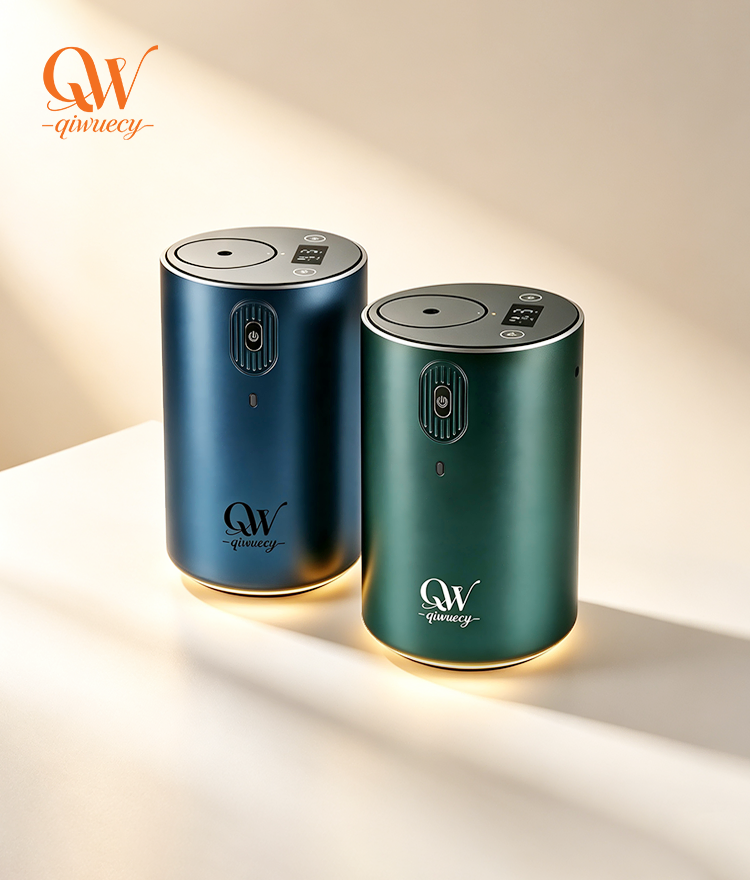
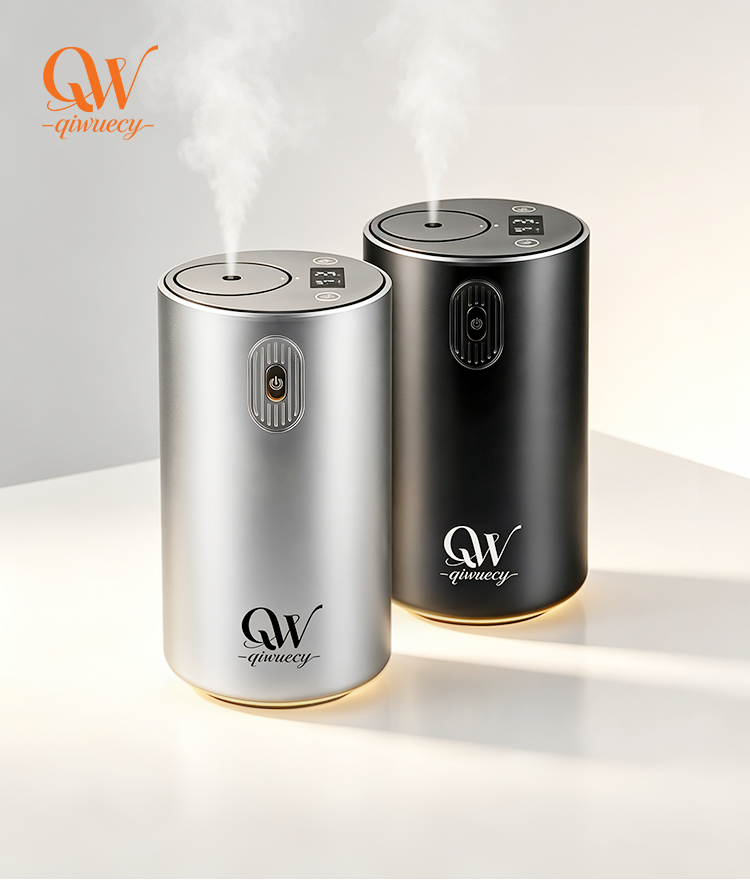
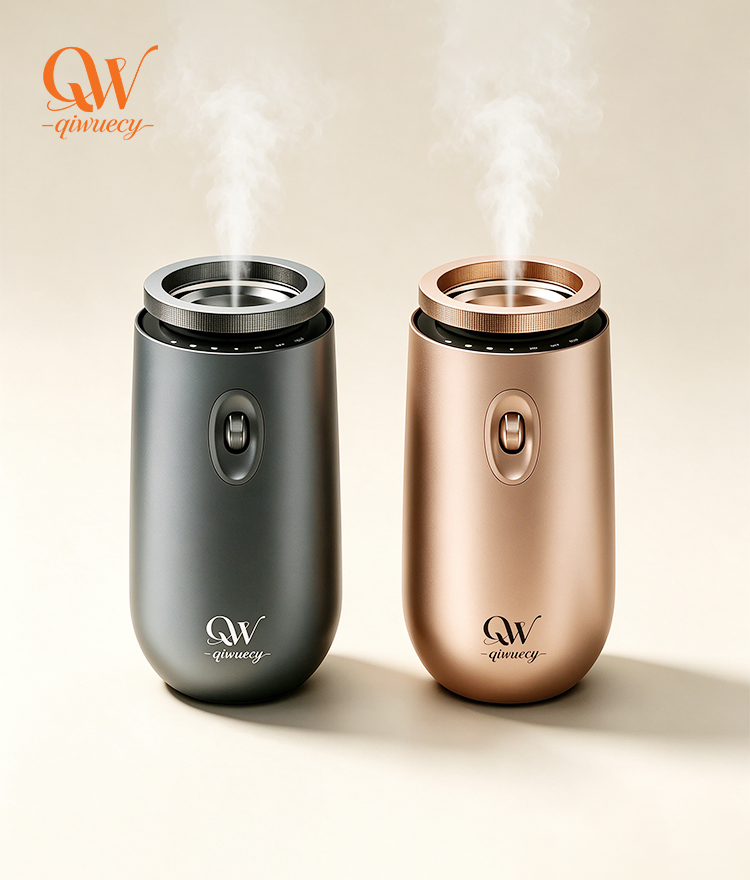
The QW30 has a compact body of roughly 7–8 cm in width and around 15 cm in height, making it suitable for cup-holder or similar placement depending on the vehicle interior. Buyers should still check whether installation blocks controls, charging ports, air vents, or passenger space.
Its home and car operating modes may also allow retailers to market one platform for several scenarios, reducing the number of product variants they need to manage.

Procurement Considerations for Bulk Buyers and OEMs
For bulk purchasing, product specifications are only part of the decision. Production repeatability, customization control, documentation, lead time, and after-sales response can have a greater impact once order volumes increase.
Supply Chain Reliability and Production Capacity
Qiwuecy reports production facilities covering roughly several thousand square meters, automated equipment, and in-house atomization-related manufacturing capabilities. These figures can provide an initial indication of scale, but procurement teams should verify which facilities and production lines apply to the QW30 before using capacity figures in sourcing decisions.
Instead of focusing on headline daily capacity, buyers should ask for realistic monthly capacity for the specific model, current workload, component lead times, and the production schedule available during peak seasons.
For large or repeat orders, useful checks include incoming-material control, in-process inspection, finished-product testing, batch traceability, packaging inspection, and procedures for handling nonconforming units.
Customization and Private Label Opportunities
OEM and ODM options may include logo engraving, housing colors, packaging, inserts, accessories, and selected fragrance combinations. Structural changes normally require more development work than cosmetic customization.
Qiwuecy also reports a portfolio of more than one hundred technical patents. Patent count alone does not demonstrate the suitability of a particular diffuser, so buyers should confirm which technologies are actually used in the model being considered.
Rather than beginning with hundreds of customized units automatically, procurement teams should first confirm the supplier's current sample and MOQ policy. A sensible process is standard sample testing → customization confirmation → pre-production sample → packaging validation → pilot order → mass production.
Certification and Regulatory Compliance
International buyers should treat documentation as a product-specific verification task rather than a checklist of logos. Different markets can have different expectations for radio-frequency functions, batteries, electrical components, packaging, materials, and labeling.
ISO 9001 is relevant to supplier quality-management processes, but it is not a product-performance approval. ISO describes ISO 9001 as a framework for establishing and maintaining a quality management system rather than certification of an individual diffuser.[4] Procurement teams should therefore assess both the supplier's management system and the model-specific product documentation separately.[4]
Customized versions should be reviewed again if important components or construction details are changed.
After-Sales Support Infrastructure
After-sales support can directly affect return rates for distributors, dealerships, and e-commerce sellers. Before ordering, buyers should confirm the warranty period currently offered for the QW30, what the warranty covers, which failures are excluded, and how defective products are handled internationally.
Also check whether the supplier provides replacement bottles, atomization components, charging accessories, troubleshooting instructions, and response procedures for recurring batch problems.

How to Choose the Right Car Aroma Diffuser: A Decision Support Guide
A structured evaluation prevents buyers from selecting a model based only on appearance or a maximum coverage claim.
Defining Application Scenarios
Start with the vehicle and user scenario. Daily commuter products need simple controls and low maintenance. Ride-hailing fleets may value rapid fragrance adjustment and easy refilling. Premium transport services may prioritize quiet operation, discreet placement, and appearance.
Waterless technology can be attractive where buyers want to avoid water handling and use concentrated fragrance formulations. However, actual suitability should still be confirmed through vehicle testing.
Budget and Operational Cost Parameters
Compare purchase price with fragrance consumption, cleaning time, expected service interval, spare parts, packaging requirements, and replacement policy.
A lower-priced ultrasonic model may still be economical for occasional personal use, while a waterless design may make more operational sense where many units must be maintained across a fleet.
Run the calculation using your actual fragrance price and intended daily operating schedule rather than supplier averages.
Technical Specification Benchmarking
For a car cold air mist aroma diffuser, benchmark the charging input, battery capacity, reservoir compatibility, noise, timer options, oil consumption, bottle sealing, and operating stability.
The QW30 uses a standard low-voltage USB-type power input and a rechargeable battery of roughly 2,000 mAh. Oil bottles are available in small capacities within approximately the 5–20 ml range depending on configuration.
Ask the supplier to define every measurement condition. “Low noise,” “long runtime,” and “large coverage” are difficult to compare unless the test method is known.
Supplier Reliability Assessment
A practical supplier scorecard is more useful than factory marketing figures.
| Evaluation Area | What Procurement Teams Should Verify |
|---|---|
| Product performance | Sample consistency and oil consumption |
| Manufacturing | Processes used for the exact model |
| Quality control | Incoming, in-process, and final inspection |
| Customization | Cosmetic versus structural options |
| Documentation | Current model-specific records |
| Capacity | Realistic monthly output and peak-season availability |
| Packaging | Vibration and transit protection |
| Spare parts | Availability and replacement procedure |
| After-sales | Warranty handling and technical response |
| Lead time | Sample, pilot, and mass-production schedule |
Practical Tips for Using and Maintaining Waterless Car Aroma Diffusers
Correct operating instructions can reduce clogging, inconsistent output, and avoidable customer returns.
Installation and Initial Setup
Place the diffuser in a stable location where it does not obstruct driving controls or passenger movement. Avoid assuming that proximity to an air vent always improves coverage; strong airflow can change fragrance distribution considerably.
Charge the device according to the manufacturer's instructions and test each operating mode before fleet deployment. For commercial programs, create one standardized setup guide so drivers or store staff do not use different settings.
Essential Oil Selection and Handling
Use fragrance formulations that the diffuser supplier has tested or confirmed as compatible. Heavy carrier oils, highly viscous blends, or formulations containing materials that leave substantial residue may affect atomization.
Do not rely on terms such as “therapeutic grade” as a technical compatibility specification. Viscosity, formulation composition, volatility, and nozzle compatibility are more useful procurement parameters.
Store fragrance oils according to the oil supplier's recommendations and avoid overfilling the bottle.
Maintenance Protocols and Cleaning Procedures
Cleaning frequency should be based on operating hours, fragrance formulation, and observed output rather than a universal one- or two-month schedule.
Follow the manufacturer's current cleaning instructions for the exact atomization system. If an alcohol-based cleaning method is recommended, confirm the appropriate concentration, duration, and material compatibility before establishing it as a fleet procedure.
Keep a simple maintenance record for larger deployments. A declining scent output, unusual noise, or irregular spray pattern can indicate that inspection is required.
Troubleshooting Common Issues
Weak fragrance output can result from low oil level, a viscous formulation, a restricted nozzle, incorrect operating settings, or airflow conditions inside the vehicle.
If the device does not power on, first check battery charge, cable compatibility, and connection quality. If routine checks do not solve the problem, use the supplier's troubleshooting procedure rather than disassembling components that may affect warranty support.

Conclusion
Ultimately, choosing between a waterless and water-based car diffuser depends on the operating environment, maintenance workload, fragrance formulation, and procurement budget. A Car Waterless Aroma Diffuser removes the need for a water reservoir and can offer compact, programmable fragrance delivery, while ultrasonic alternatives may remain suitable where lower upfront cost and lighter-duty use are priorities.
For fleet operators, dealerships, and aftermarket retailers, the strongest decision comes from testing oil consumption, noise, battery behavior, leakage resistance, maintenance requirements, and packaging before scaling an order. Supplier capability should be judged through model-specific evidence and pilot testing rather than marketing claims alone.
FAQ
1. Can waterless diffusers operate safely in all vehicle types?
Buyers should not assume that one diffuser is suitable for every vehicle. Check placement, charging compatibility, bottle sealing, operating temperature guidance, and airflow conditions in representative vehicle models before fleet deployment. For OEM or dealership programs, testing several vehicle interiors is preferable to relying on a general compatibility claim.
2. How long does fragrance last with waterless technology?
There is no universal service period. Fragrance duration depends on bottle capacity, atomization intensity, timer settings, daily usage, oil viscosity, and cabin airflow. Procurement teams should ask suppliers for consumption ranges and then verify them with the actual fragrance formulation planned for sale.
3. Are customization options available for bulk orders?
Customization may include logos, housing finishes, packaging, accessories, and fragrance combinations. MOQ and development time normally vary according to customization complexity. Buyers should confirm standard-product MOQ, custom MOQ, sample cost, tooling requirements, and pre-production approval procedures before budgeting a project.
4. What certifications ensure product quality?
No single certification guarantees complete product quality. Buyers should verify supplier quality-management documentation separately from model-specific product records and destination-market requirements. For customized products, confirm whether changes to batteries, electronics, housing, or other components affect existing documentation.
Partner with Qiwuecy for Automotive-Grade Fragrance Solutions
Qiwuecy manufactures automotive fragrance products and supports OEM and ODM projects involving product appearance, branding, packaging, and atomization-related development. The company reports more than a decade of experience in atomization technology, a portfolio of more than one hundred patents, and manufacturing facilities covering several thousand square meters; procurement teams should verify current figures and the capabilities relevant to the selected model during supplier qualification.
For wholesale, dealership, fleet, and private-label projects, buyers can begin with specification confirmation and sample testing before discussing pilot quantities and mass-production schedules. Contact the sourcing team at marketing@qiwuecy.com to confirm current MOQ, customization options, lead times, warranty terms, and available documentation. The company's Car Waterless Aroma Diffuser solutions can then be evaluated against the intended vehicle, fragrance formulation, and commercial deployment requirements before a larger purchase commitment.
References
1. Schwartz-Narbonne, H., Du, B., & Siegel, J. A. (2021). Volatile organic compound and particulate matter emissions from an ultrasonic Essential Oil diffuser. Indoor Air, 31(6), 1982–1992. DOI: 10.1111/ina.12845.
2. Angulo-Milhem, S., Verriele, M., Nicolas, M., & Thevenet, F. (2021). Indoor use of essential oils: Emission rates, exposure time and impact on air quality. Atmospheric Environment, 244, 117863. DOI: 10.1016/j.atmosenv.2020.117863.
3. Angulo-Milhem, S., Verriele, M., Nicolas, M., & Thevenet, F. (2023). Full-scale determination of essential oil diffusion: Impact on indoor air quality. Atmospheric Environment, 315, 120141. DOI: 10.1016/j.atmosenv.2023.120141.
4. International Organization for Standardization. (2015). ISO 9001:2015 — Quality management systems — Requirements. ISO.
This article is published by Qiwuecy and includes references to Qiwuecy products. Product specifications and certification status should be confirmed with the supplier for the exact model and production configuration.
Online Message