Nov 2, 2026
Rose Essential Oil B2B Sourcing: Otto vs Absolute, Origin Pricing & Quality Verification
If you have ever asked for a quotation on rose oil and received two very different items at two very different prices, you are not alone – most first-time purchasers are not aware that “rose oil” really refers to two chemically separate materials generated by two unique techniques. This tutorial dispels that myth before you waste another source cycle thinking. By the end, you’ll know how to differentiate Otto from Absolute, which origin matches your formulation and budget, how to interpret a GC-MS report well enough to detect a diluted batch, and what grade to demand for a spa line, a beauty recipe, or a gift collection. All the recommendations below are based on one phrase to remember when requesting samples: rose damascena single Essential Oil.
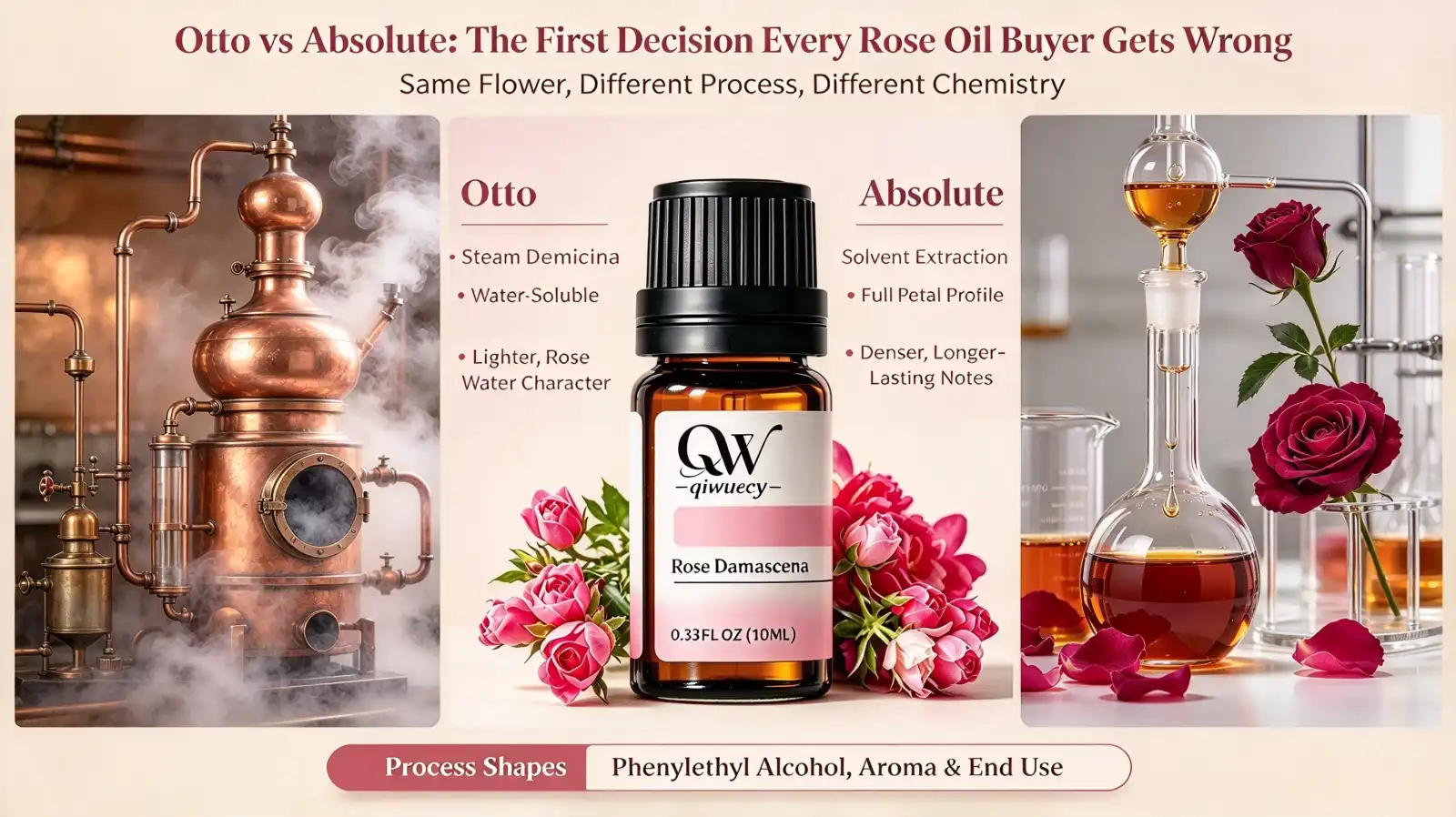
Otto vs Absolute: The First Decision Every Rose Oil Buyer Gets Wrong
What Steam Distillation Delivers: Rose Otto's Chemistry and Character
Rose otto is produced by steam distilling fresh rose petals, generally twice, with the second (cohobation) drawing out water-soluble aromatics left in the first distillation. The result is a lighter, more translucent oil dominated by citronellol and geraniol with a fresh, almost green-citrus opening that many consumers describe as cleaner than the anticipated “rose.” These molecules solidify at chilly room temperature; Thus, real Otto is typically semi-solid below roughly 18–21°C depending on the batch and has to be warmed gently before use – an expected quality, not a defect. While this partial solidification serves as a useful initial screening method upon arrival, it is an auxiliary check and cannot replace a full GC-MS report..
What Solvent Extraction Delivers: Rose Absolute's Richer, Rounder Profile
Rose absolute does not distill at all. Firstly, the petals are treated with a solvent to obtain a waxy solid. The petals are then washed with ethanol for the absolute. This collects phenylethyl alcohol, the molecule that is lost in steam distillation as it dissolves into the hydrosol rather than the oil. That one difference impacts the way the two materials both smell and perform: Absolute smells warmer, thicker, and more "petal-like," more like smelling a rose with your face in the bloom. According to GC-MS studies on rose extracts and flowers, phenylethyl alcohol and other volatile rose compounds show significant differences depending on extraction methods, which helps explain the distinct aroma profiles of rose otto and rose absolute.[4] Additionally, it takes less flower material per kilo of finished oil than Otto does, which is part of the reason Absolute tends to land at a friendlier price range for manufacturers desiring rose’s full essence on a smaller budget.
Aroma and Application: When to Choose Otto Over Absolute
The honest truth is neither of the materials is “better” - they’re made for distinct tasks. Otto’s lighter, more volatile character is better suited for applications where the oil is resting directly on skin for a longer amount of time, since its lighter chemical profile and higher volatility and clearer top note layer well in massage oils and leave-on skincare without feeling heavy. Absolute’s thicker, more obstinate nature is better suited to exquisite fragrance and long-wear goods, where you want the rose note still legible hours later. If your team is unsure where to go with a new rose damascena single essential oil line, start by asking how long the product lingers on skin and how loud you want the rose note to read.
Can You Use Both? Layering Otto and Absolute in One Formulation
Most expert perfumers don’t choose one or the other – they use both, using Otto to provide body in the middle of a mix and Absolute to add brightness to the top. The dual-sourcing strategy is a mainstay for luxury cosmetics and fine fragrance firms in search of the entire range of rose’s character. If you’re a B2B buyer making a private-label line, it also makes it easier to oversee quality if both components come from the same source, since you’ll have one set of origin and testing paperwork to deal with rather than two supply chains to audit.
Fast Facts for Rose Oil Buyers
What to know before you request a quote:
- Otto and Absolute are two different materials from the same flower, not two grades of one product — confirm which you need before requesting pricing.
- Turkey and Bulgaria together supply most of the world's Rosa damascena, each with a slightly different character.
- Genuine rose oil is among the costliest natural raw materials in the fragrance industry, with pricing that shifts year to year based on harvest and regional conditions.
- Citronellol-to-geraniol ratios on a GC-MS report are your fastest read on authenticity — request one with every quotation.
- Sample sizes are typically small (often starting around 10ml) given the material's cost, so plan your evaluation around a limited working quantity.
| Category | What to Confirm |
|---|---|
| Certifications to request | ISO 9001, GMP compliance, Certificate of Analysis (COA), batch-specific GC-MS report, species and origin declaration |
| Sample sizes | Working evaluation samples generally start from around 10ml given material cost, scaling up once quality is confirmed |
| Lead time | Sample dispatch is usually fast; bulk production timing depends heavily on harvest season and current stock availability |
| Sample policy | Most suppliers offer a paid or trial-size sample with COA and GC-MS report attached before any bulk commitment |
| Primary application scenarios | High-end spa and wellness rituals, skincare and cosmetic formulation, fine fragrance, gifting and boutique product lines |
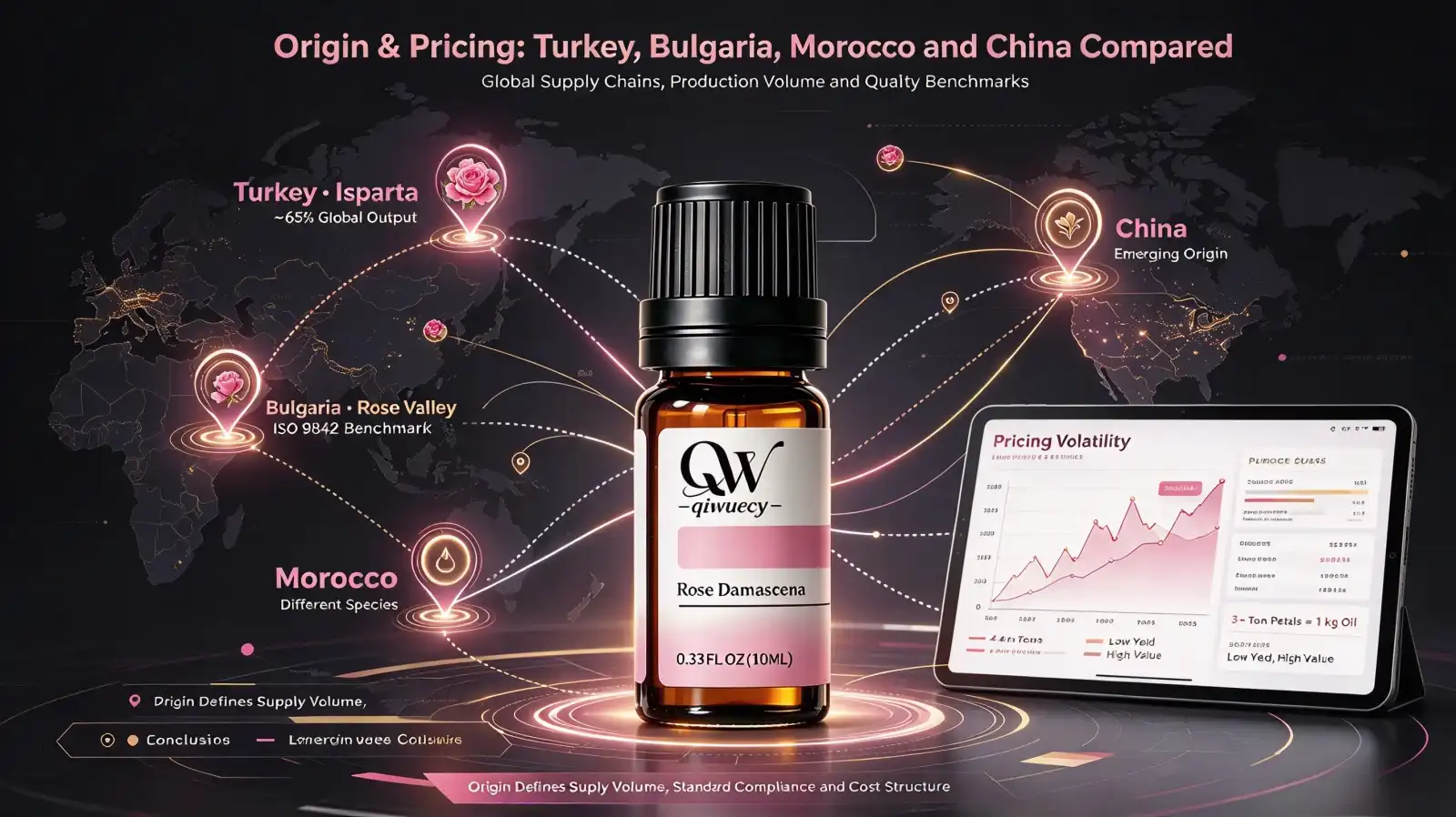
Origin & Pricing: Turkey, Bulgaria, Morocco and China Compared
Turkey's Isparta Region: Volume Leader for Rosa Damascena
Isparta, in southwestern Turkey, supplies a large majority of the world's Rosa damascena oil — commonly cited at around 60% or more of global output — thanks to generations of cultivation know-how and a climate suited to the crop. Because production runs at scale here, Turkish origin often gives buyers steadier availability than smaller-producing regions, which matters for recurring orders rather than a one-off batch. The trade-off: at this scale, quality can vary more between individual farms and cooperatives than in more consolidated production regions, so origin alone isn't a substitute for requesting batch-level documentation on your rose damascena single essential oil order. According to economic studies on Rosa damascena cultivation and regional oil production, production conditions, harvest scale, and cultivation practices strongly influence supply stability and cost structure across producing regions.[5]
Bulgaria's Rose Valley: The Benchmark Origin for Otto Quality
Bulgaria's Rose Valley, centered around Kazanlak, has effectively set the reference standard the rest of the industry gets measured against — the international quality specification for rose otto (ISO 9842) was built around Bulgarian production practice. Buyers who prioritize consistency and traceability over the lowest possible cost often lean toward Bulgarian origin, particularly for skincare or wellness applications where batch-to-batch predictability protects a finished formula. Bulgarian rose oil tends to sit at a comparable or somewhat higher price point than Turkish material, reflecting smaller harvest volumes and a longer-established reputation among buyers. According to ISO 9842, oil of rose (Rosa × damascena Miller) quality specifications define key quality parameters used for evaluating rose oil characteristics and authenticity.[1]
Morocco's Rose Centifolia: A Different Species, A Different Use Case
Morocco, along with the Grasse region of France, historically associated with Rosa centifolia rather than Rosa damascena, and the two species produce noticeably different aroma profiles even though both are marketed broadly as "rose oil." Centifolia tends to read softer and more honeyed, closer to classic French rose accords than the brighter, citronellol-forward Damascena profile. If a supplier offers Moroccan rose as a substitute for a Damascena order, confirm the species explicitly — it's a different raw material that may not perform the way your formulation expects.
China's Emerging Rose Oil Regions: What Buyers Should Know
Domestic Rosa damascena and Rosa rugosa cultivation has expanded in parts of China over recent years, giving buyers a newer origin worth watching, particularly those already sourcing other botanical ingredients from Chinese suppliers and wanting to consolidate logistics. However, buyers must be aware that Rosa rugosa (often marketed as Chinese rose) is a distinct species from Rosa damascena, with a significantly different chemical profile and aroma; they are not interchangeable. Procurement teams must explicitly confirm that the supplier's COA and product labels state Rosa damascena, not merely a generic "rose oil." Production volumes remain smaller than the established Turkish and Bulgarian industries, so consistency across seasons is worth verifying directly rather than assuming from origin alone. As with any newer producing region, request a season or two of GC-MS history where available.
Quality Verification: Reading a Rose Oil GC-MS Report Like a Buyer, Not a Chemist
Citronellol and Geraniol: The Ratio That Tells You Most
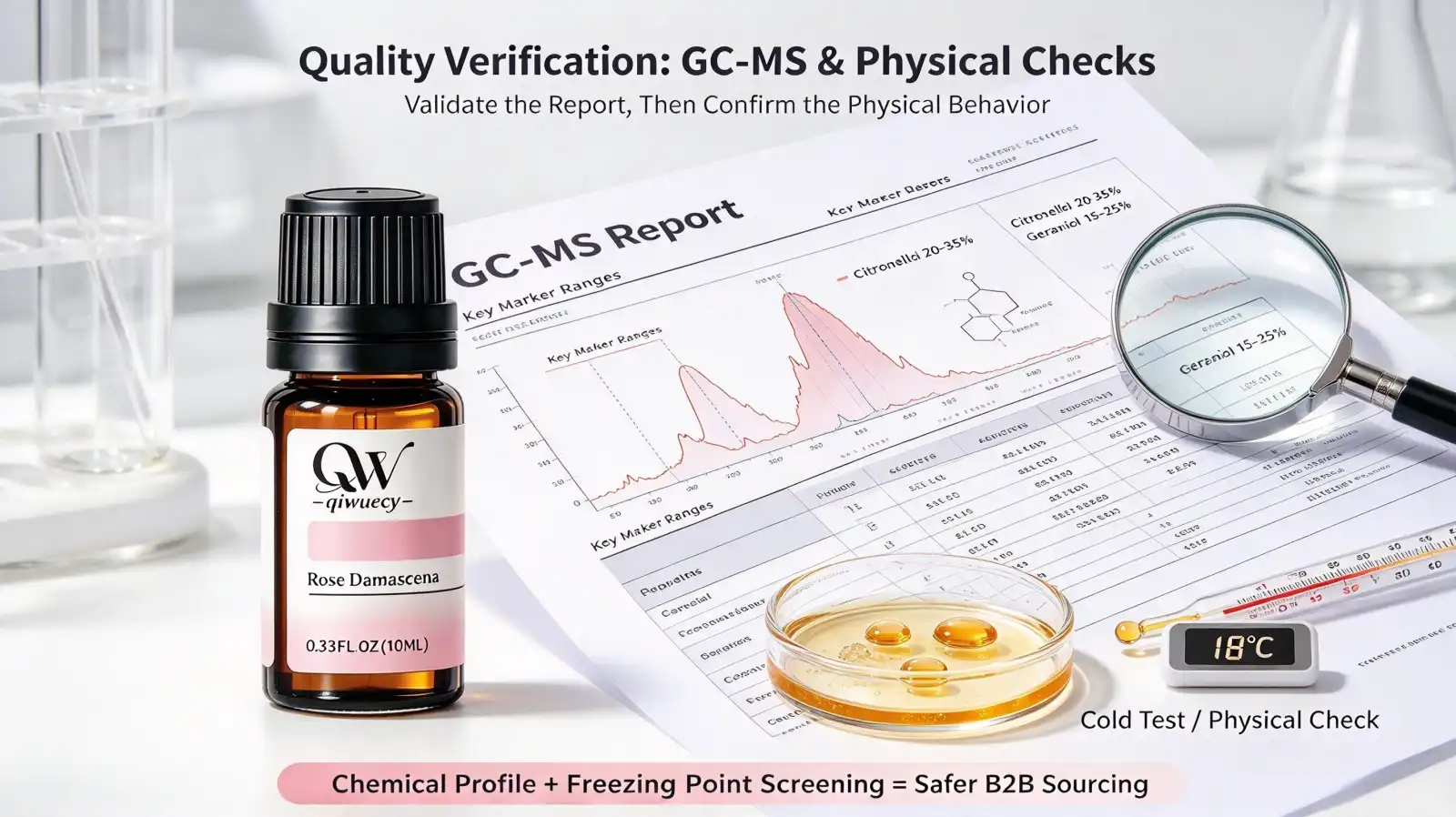
You don't need a chemistry background to use a GC-MS report effectively — just know which two or three numbers matter most. For genuine rose otto, citronellol typically makes up roughly a fifth to a third of the total composition, with geraniol close behind and nerol trailing at a smaller share; together these three compounds should dominate the profile. If a report shows geraniol running unusually high relative to citronellol, or a profile that looks "too clean," treat that as a prompt to ask more questions before your rose damascena single essential oil order moves to bulk stage. According to GC-MS authentication studies on commercial rose oils, analyzing characteristic chemical markers and trace compounds helps distinguish genuine Rosa damascena oil from adulterated materials.[2]
The Geranium and Palmarosa Problem: How Rose Oil Gets Cut
Because genuine rose oil is so costly, it has a long history of being stretched with cheaper oils sharing some of its scent character — most commonly geranium oil and palmarosa oil, both naturally rich in geraniol and able to shift a blend's aroma close enough to pass a casual smell test. Palmarosa in particular is favored by adulterants because it barely changes the oil's density or optical rotation, making it harder to catch without lab analysis. This is why a GC-MS report matters more for rose than almost any other oil category — trace markers, not just the headline molecules, separate a genuine batch from a stretched one. Research on adulteration detection methods for Damask rose essential oil has highlighted the importance of chemical profiling approaches for identifying dilution with lower-cost botanical oils.[3]
Physical Checks Beyond the Lab Report
Lab documentation should always come first, but a few physical checks can support what the paperwork tells you. Genuine rose otto partially solidifies into small crystals when chilled and returns to liquid at room temperature — a behavior that's difficult to fake convincingly. Color is a softer clue: Otto typically runs pale yellow to light amber, while Absolute is noticeably darker and thicker. Neither check replaces a GC-MS report, but both are useful sanity tests to run on arrival while lab results are still pending.
Indicative Compound Ranges: Rose Otto (ISO 9842:2003) vs Common Adulterants
| Marker Compound | Genuine Rose Otto (ISO 9842:2003 Limits) | Palmarosa Oil (Adulterant Signal) | Geranium Oil (Adulterant Signal) |
|---|---|---|---|
| Citronellol | 20–35% | Low, minor presence | Often the dominant compound |
| Geraniol | 15–25% | Very high, often the dominant compound | Present, moderate to high |
| Nerol | 5–12% | Minimal or absent | Minimal or absent |
| β-Damascenone | 0.1–0.5% | Generally absent | Generally absent |
(Note: Trace compounds like rose oxide are also characteristic of authentic Otto, but β-damascenone is a key ISO-standardized marker. Any batch must be evaluated against these ISO 9842:2003 limits alongside the full GC-MS profile before bulk commitment.)
What a Trustworthy Supplier's Documentation Should Include
Beyond a GC-MS report, ask for a Certificate of Analysis stating the botanical species explicitly (Rosa damascena, not just "rose"), the extraction method, harvest origin and ideally harvest year, and whether the batch is single-origin or a blend. Suppliers who hesitate on this detail, or whose pricing seems disconnected from rose oil's harvest-limited supply, deserve a second look before you commit budget. According to industry sourcing guidance from professional aromatherapy organizations, botanical identification, purity verification, and supporting documentation are essential parts of responsible essential oil procurement.[6]
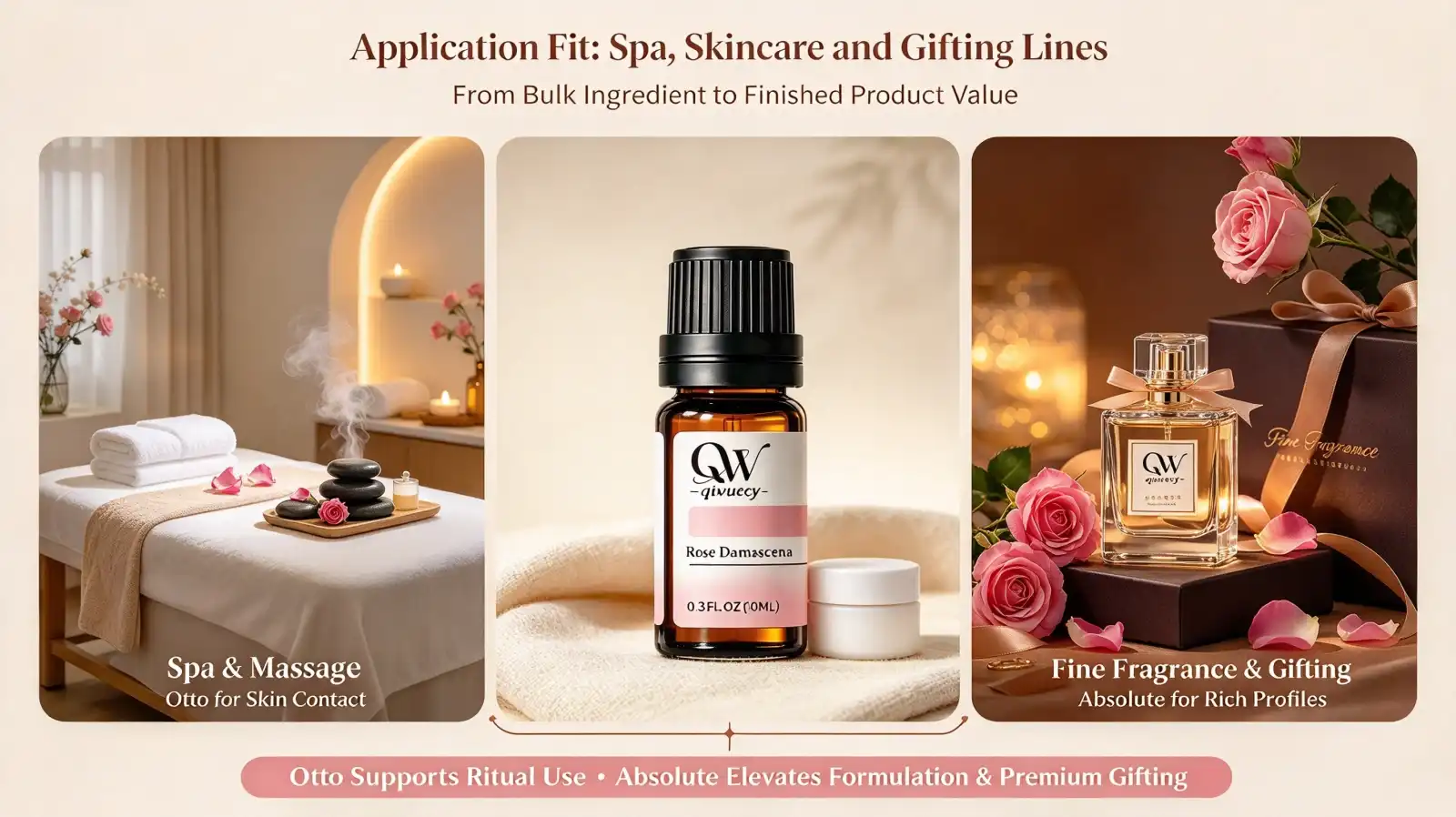
Application Fit: Spa, Skincare and Gifting Lines Need Different Rose Materials
High-End Spa and Wellness: Why Otto Often Wins for Skin-Contact Rituals
Spa brands building massage oils, facial treatments, or body rituals where product sits on skin for an extended session tend to favor Otto for its lighter texture and cleaner top note, layering well into carrier oils without overwhelming a treatment room. Because Otto is used at very low percentages given its cost and potency, a modest working stock goes a long way, offsetting its higher per-kilogram price relative to Absolute over a full production run.
Skincare Formulation: Balancing Cost, Stability and Scent Intensity
For everyday skincare lines — serums, creams, facial mists — cost efficiency and repeatable scent across batches typically matter more than capturing rose's fullest character. This is where Absolute's more favorable yield economics can make it the practical choice, provided packaging accounts for its darker color and thicker consistency. Brands should pilot-test any new rose damascena single essential oil batch in the base formula before scaling, since carrier interactions can shift how the note reads once blended.
Fine Fragrance and Gift Sets: Where Absolute's Depth Pays Off
Gift collections and fine fragrance lines benefit from Absolute's fuller, more tenacious character, especially in products meant to read as a scent-forward moment rather than a subtle background note. Buyers building seasonal gift lines often pair Absolute with complementary botanicals to create a signature accord that reads as more layered, supporting premium positioning without Otto's higher cost base.
Conclusion
Sourcing rose damascena single essential oil well comes down to three habits: know whether you need Otto or Absolute before requesting a quote, match origin to your formulation and budget instead of the most familiar name, and verify a GC-MS report against known citronellol-geraniol ranges before scaling to bulk. Buyers who build this into their process avoid overpaying for stretched material. Ready to compare a genuine batch against your current supplier? Request a sample and see the difference for yourself.
FAQ
Q1: How do I know I'm not paying for rose oil that's been cut with cheaper oils?
Request a batch-specific GC-MS report and check the citronellol-to-geraniol ratio against known ranges for genuine Rosa damascena. Unusually high geraniol relative to citronellol, or a profile missing rose oil's characteristic trace compounds, are signs worth questioning before ordering in bulk.
Q2: What's a realistic sample size to request when evaluating a new rose oil supplier?
Given rose oil's cost, most suppliers work with small evaluation samples, often starting around 10ml — enough for an aroma panel and a formulation pilot test before committing to a larger order.
Q3: Why does rose oil pricing move around so much compared to other essential oils?
Yield is exceptionally low relative to the flower volume required—it takes roughly 3 to 4 tonnes of rose petals to produce just a single kilogram of oil. Combined with short, weather-sensitive harvests concentrated in a handful of regions, this extreme processing ratio means that even minor shifts in a single season’s conditions can cause significant price swings compared to most other botanical oils.
Q4: Should I choose Otto or Absolute if I'm not sure which my formulation needs?
Choose Otto for products that sit directly on skin for extended periods, like massage oils and leave-on skincare, and Absolute for fragrance-forward products like fine perfumery or gift lines where a fuller, longer-lasting rose note matters more than a light texture.
Source Rose Damascena Single Essential Oil From Qiwuecy
Qiwu Technology (Shenzhen) Co., Ltd. brings 14 years of atomization and natural rose damascena single essential oil R&D, over 100 invention patents, and ISO9001/GMP-certified manufacturing to every botanical ingredient we supply. Our team works with formulators, spa brands, and distributors to match the right origin and material — Otto or Absolute — to your application, backed by documentation you can verify. Request your GC-MS report and a working sample at marketing@qiwuecy.com, and our sourcing specialists will help you move from first inquiry to a confirmed order without the guesswork.
References
1. International Organization for Standardization, ISO 9842 — Oil of Rose (Rosa × damascena Miller), quality specification standard.
2. Botanical Adulterants Prevention Program, bulletin on Damask rose (Rosa × damascena) essential oil adulteration and detection methods.
3. Foods journal, study on quantification of geranium and palmarosa essential oil adulterants in Rosa damascena oil using spectroscopic and chemometric methods.
4. ACS Measurement Science Au, study on rose alcohol composition analysis in rose extracts and flowers via GC-MS and headspace solid-phase microextraction.
5. Bulgarian Journal of Agricultural Science, economic analysis of Rosa damascena cultivation and oil production in Isparta, Turkey.
6. International Fragrance Association (IFRA), industry reference materials on rose otto and rose absolute composition and perfumery use.
Online Message
YOU MAY LIKE
High quality diffuser manufacturer