Sep 11, 2026
How to Achieve More Uniform Essential Oil Diffusion? Secrets of Nozzle Design and Impact Atomization Structure
Learn how aroma diffuser nozzle design and impact atomization create finer mist and more uniform diffusion. We explain the engineering behind guide slopes, offset mist holes, and spacer impact parts. Featuring the QW015 Dual-Nozzle Waterless Aroma Diffuser. Essential reading for OEM waterless aroma diffuser buyers.
A high-quality aroma diffuser is not judged solely by how quickly it releases fragrance, but by how evenly and consistently it fills a space. Uneven diffusion creates “hot spots” of intense scent near the device while the rest of the room remains stale. Worse, large mist particles that fail to evaporate can condense on surfaces, leave oily residue, and even drip back into the device, causing waste and potential clogging.
This article takes a deep dive into two critical engineering solutions that solve these problems: aroma diffuser nozzle design and impact atomization structure. Together, they form the backbone of a uniform diffusion structure that produces fine, long-lasting, and evenly distributed fragrance. Our products are built on exactly this technical approach, achieving finer mist particles and more uniform diffusion.
2. The Problem with Traditional Atomizing Heads: Large Particles and Oil Dripping
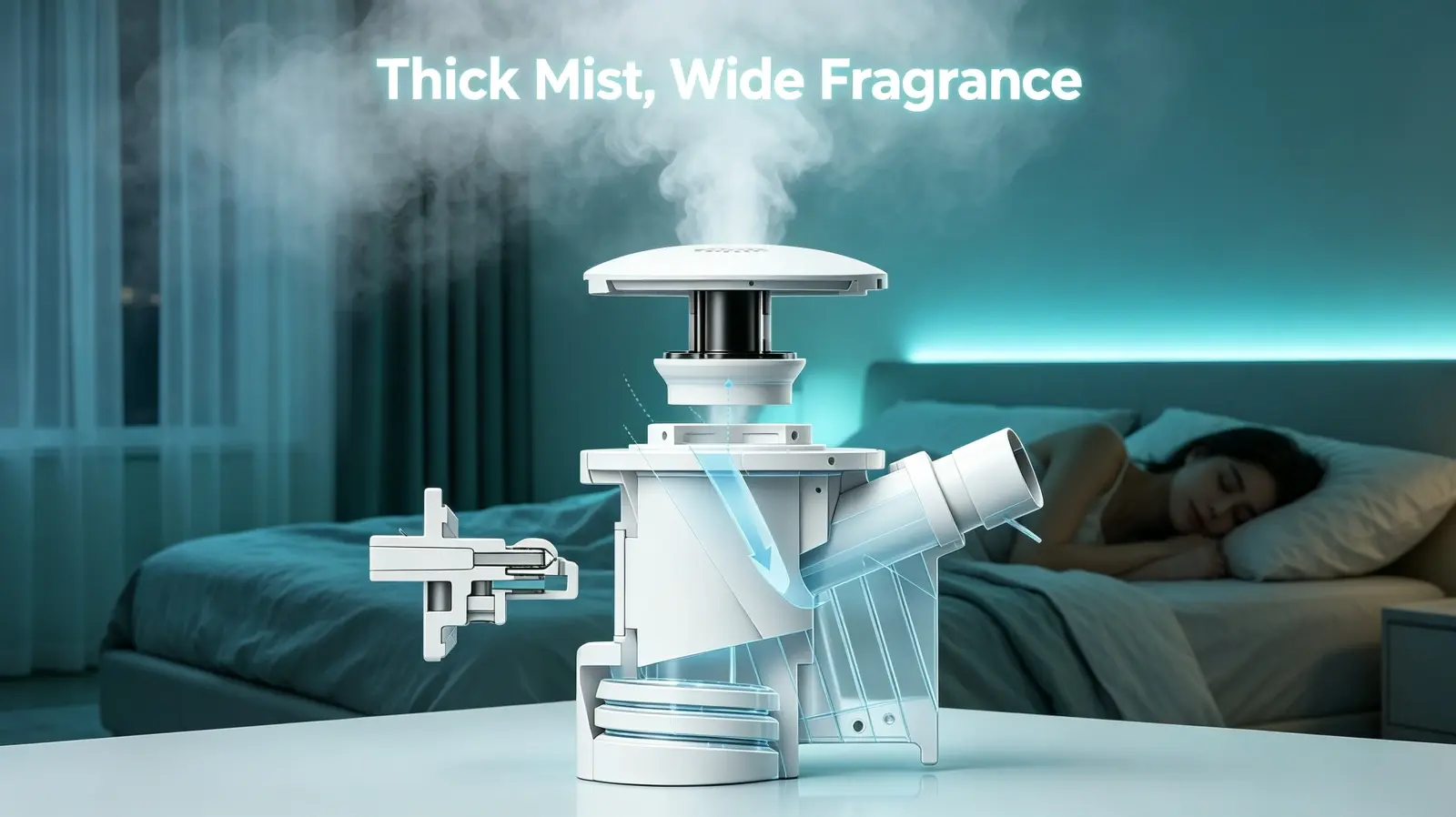
Conventional atomizing heads often rely on a simple open mist outlet. When pressurized air mixes with Essential Oil, the resulting droplets vary widely in size. Larger droplets carry too much mass to remain airborne. Instead of drifting and evaporating, they:
Fall onto the mist outlet‘s inner wall and accumulate.
Flow backward toward the atomizing core, causing oil return and reduced output.
Drip from the outlet, creating mess and wasting expensive essential oil.
Moreover, the outlet geometry often fails to accelerate the mist. Without a constricted exit, the air-oil mixture moves slowly, producing coarse particles that spread poorly. This is why many users complain that their diffuser “spits” oil or leaves a sticky film on nearby surfaces. Research on twin-fluid atomizers has demonstrated that increasing gas inlet pressure and optimizing nozzle orifice geometry significantly reduce droplet size and improve uniformity, confirming that nozzle design is the decisive factor in atomization quality [2†L4-L11].
3. Fine Mist Atomization: How Nozzle Design Accelerates and Refines the Mist
The first key to uniform diffusion is controlling the mist as it exits the atomizing chamber. This is where fine mist atomization begins—at the nozzle.
3.1 The Core of Aroma Diffuser Nozzle Design
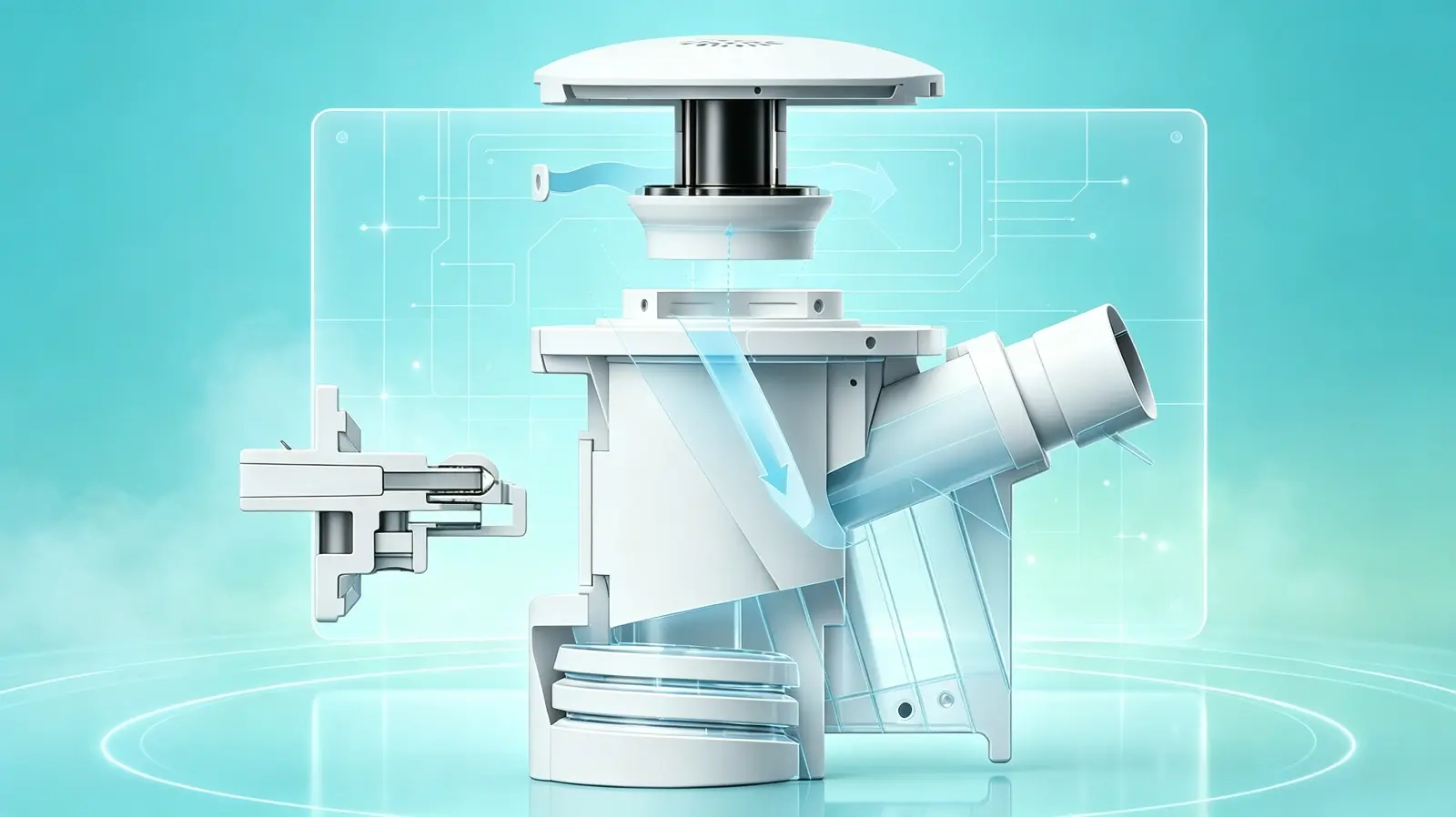
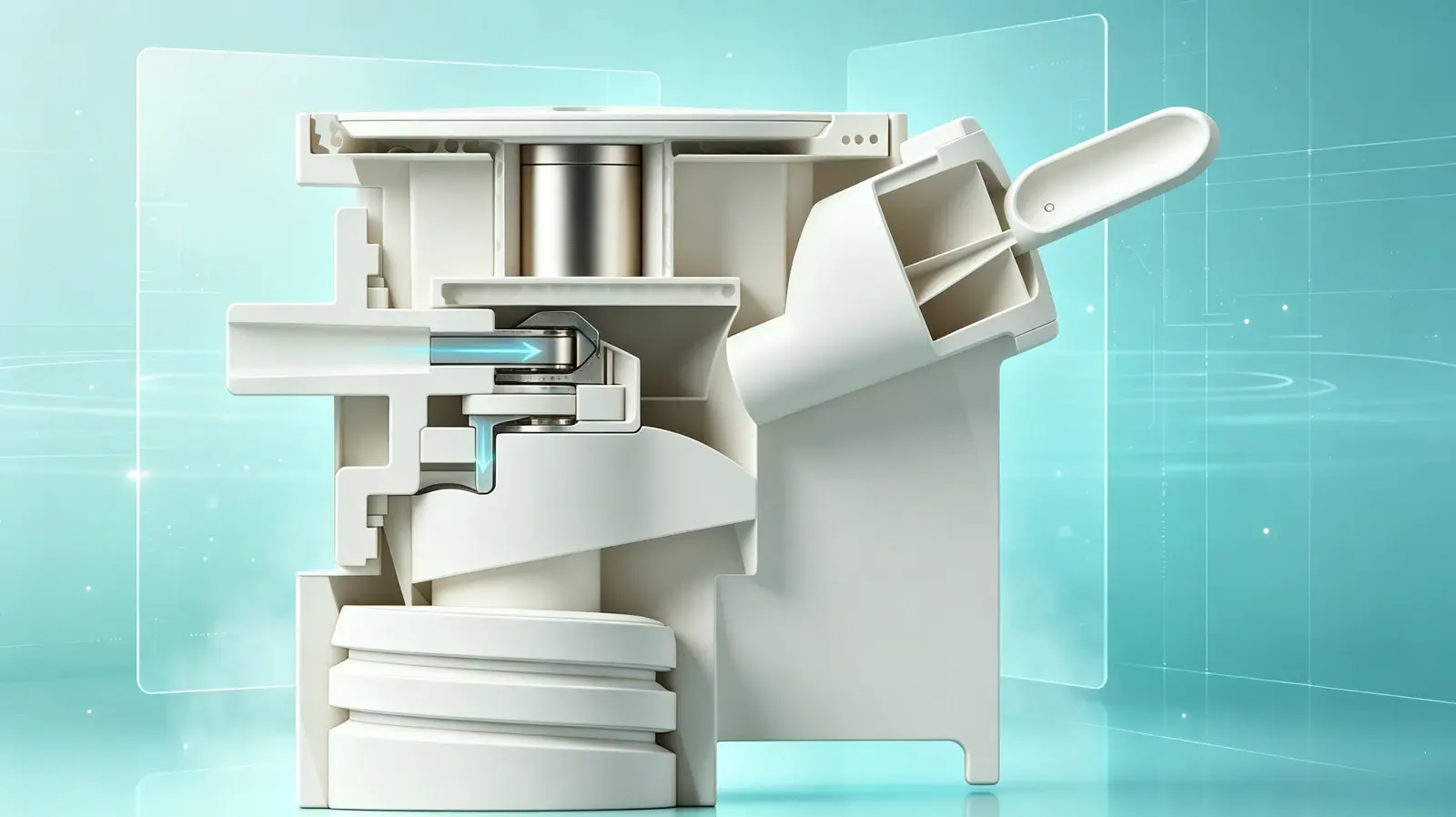
The nozzle used in our products is a half-closed tubular component that seals the output end of the mist outlet. It is not a simple open pipe; instead, it features a precisely formed mist hole (orifice) that is offset toward the top of the outlet. This offset is not arbitrary—it creates a deliberate air passage between the lower wall of the mist outlet and the mist hole.
By forcing the air-oil mixture through this narrowed, offset passage, the nozzle increases the flow velocity. Faster flow means smaller droplets. This is the essence of fine mist atomization: accelerate the mixture, and it naturally breaks into finer particles. Anti-reflux atomization nozzles in the industry employ similar principles, using gas channels to create negative pressure at the liquid outlet for more efficient atomization [1†L10-L15].
3.2 Guide Slope and Offset Mist Hole: The Acceleration Mechanism
Two geometric features make this acceleration possible:
Inward-sloping nozzle inner wall: Along the direction of mist flow, the nozzle’s internal cross-section gradually narrows. This creates a converging channel that squeezes the mixture, increasing its speed.
Guide slope: An additional angled surface is positioned just inside the mist hole. This guide slope has a steeper angle than the inner wall, further redirecting the flow and reducing the spray angle relative to vertical.
The result is a high-velocity, well-directed stream of fine droplets. Because the mist hole is offset upward, the droplets are ejected at an upward angle rather than straight out. This upward trajectory allows the mist to cover a larger area above the diffuser, improving perceived diffusion even before the droplets fully evaporate.
4. Impact Atomization: Breaking Down Large Particles with a Spacer
Even with an optimized nozzle, some larger droplets remain. To achieve truly uniform diffusion, we need a second stage: impact atomization. This is where the spacer comes in.
4.1 The Spacer and Its Impact Part
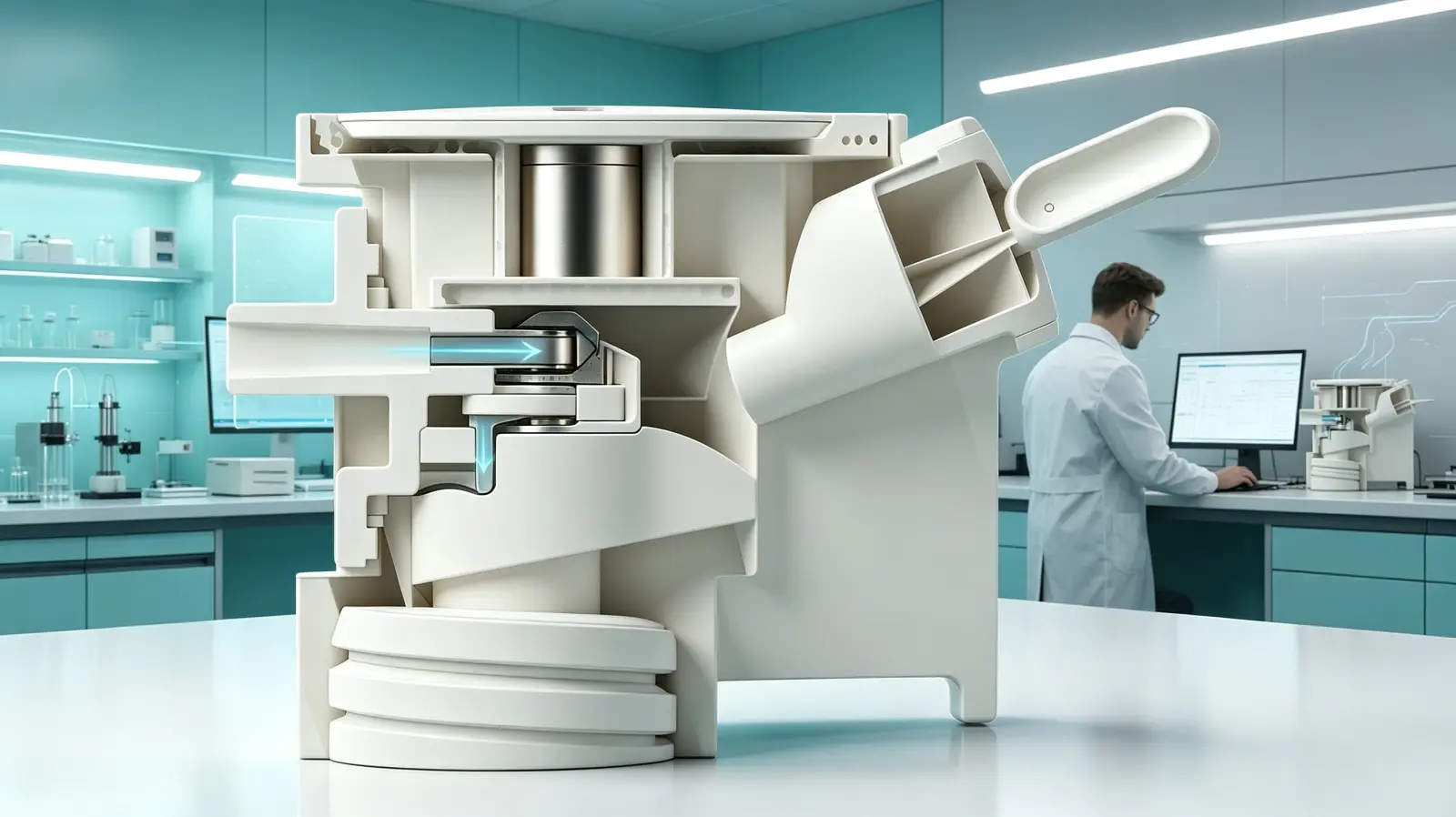
Inside the mist chamber, we place a spacer that divides the chamber into two sections. The atomizing core sits in the lower section and directs its output toward an impact part on the underside of the spacer.
When the mist—still containing a range of droplet sizes—strikes this impact part, the larger, heavier droplets shatter into smaller ones. This mechanical break-up is highly effective because it targets exactly the particles that would otherwise cause dripping and uneven diffusion. The impact part may be concave or convex, increasing surface contact and improving break-up efficiency. Numerical simulations of gas-liquid impinging-jet nozzles have shown that reshaping the impingement surface can improve atomization quality by nearly 30% under identical boundary conditions, validating the effectiveness of this structural approach [4†L25-L27].
4.2 Inclined Surface and Guiding Path for Uniform Diffusion Structure
After impact, the droplets must be guided toward the final exit without re-coalescing or pooling. The spacer‘s underside is therefore designed with an inclined surface that slopes downward from the impact part toward a first mist outlet hole located away from the impact zone.
This inclined surface serves two purposes:
Guiding fine droplets: The smallest droplets, now light enough to remain airborne, flow along the inclined surface toward the exit hole. The slope helps maintain their momentum and prevents stagnation.
Returning large droplets: Any droplets that are still too large to float will, under gravity, slide down the inclined surface and eventually return to the atomizing base or the oil bottle. This self-cleaning action reduces oil waste and keeps the diffusion path clear.
A transition surface may also be provided at the bottom of the spacer, with a slight angle (β) relative to the inclined surface. This fine-tunes the flow path and ensures that the droplets are directed smoothly toward the exit hole.
5. How Nozzle and Spacer Work Together for Uniform Diffusion
The magic of this design lies in the synergy between the nozzle and the spacer:
Stage 1 – Nozzle acceleration: The nozzle constricts and accelerates the mist, creating a high-velocity stream with finer initial droplets.
Stage 2 – Impact break-up: The spacer‘s impact part shatters remaining large droplets, ensuring that only fine particles continue.
Stage 3 – Guided exit: The inclined surface channels fine droplets toward the outlet while allowing oversized droplets to drain back.
The result is a uniform diffusion structure that produces a consistent, wide-reaching mist. Because the droplets are smaller, they stay suspended longer, travel farther, and evaporate completely—leaving no oily residue. Users experience a more even fragrance throughout the room, with no spitting or dripping.
This two-stage atomization approach aligns with established research on secondary droplet breakup in impaction-pin nozzles, which confirms that combining primary nozzle acceleration with secondary impact break-up produces superior atomization performance [4†L10-L14].
6. Product Spotlight: QW015 Dual-Nozzle Waterless Aroma Diffuser
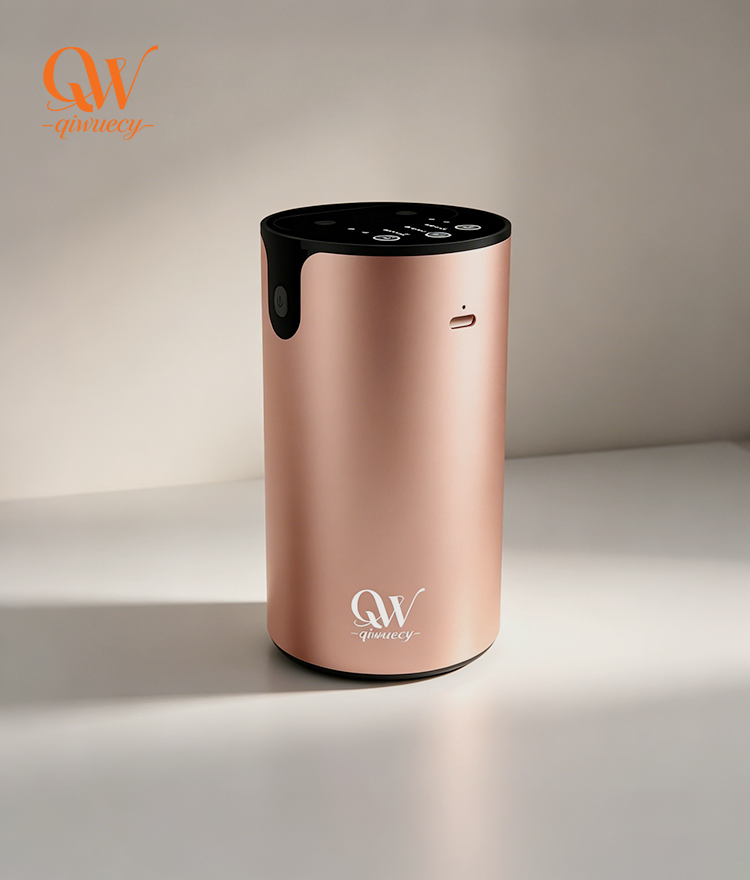
Knowing the engineering principles is one thing, but how do they translate into a real-world product? The QW015 Dual-Nozzle Waterless Aroma Diffuser is the ultimate culmination of our noise-reduction technology and the nozzle-and-spacer architecture described in this article.
Why the QW015 Delivers Exceptional Mist Output and Uniform Diffusion
· Dual-Nozzle Design, Independent Dual-Path Atomization: The QW015 features a revolutionary dual-nozzle structure supporting two 10ml essential oil bottles that can work simultaneously or independently. Each nozzle employs the fine mist atomization technology described above. The dual-path configuration delivers larger mist output and wider coverage, effortlessly meeting the diffusion needs of large spaces.
· Compressed Air Atomization System, Fine and Uniform Particles: The QW015 is equipped with a compressed air atomization system that produces extremely fine mist particles, allowing fragrance to diffuse uniformly throughout the space. The spray method is a compressed air system, ensuring every drop of essential oil is fully atomized. Waterless Diffusers typically use two-fluid atomization technology to transfer essential oil into 1-3 nanometer mist without water or heat, preserving the molecular structure of essential oils for a purer, longer-lasting fragrance [3†L15-L19].
· Waterless Pure Essential Oil Technology, Zero Residue: Adopting a waterless design, it directly atomizes 100% pure essential oil without adding water. Compared to traditional ultrasonic diffusers, it completely eliminates water scale residue and moisture issues, achieving higher oil utilization and a cleaner device.
· Dual Bottles, Dual Scents, One-Button Switching: The two 10ml essential oil bottle design allows you to switch between different fragrance types freely without changing bottles, adapting to different scenarios and moods.
· Smart Timer and Portable Battery Life: Supports 1H/3H/6H three-level timer function, built-in 2000mAh rechargeable battery, 3-5W low power consumption, wireless and portable, suitable for home, car, office desk, and travel.
· Aviation-Grade Materials and Precision Craftsmanship: Made of PP+PC+POM and aluminum alloy materials, sturdy and durable, combining high-end texture with long-lasting service life.
Who Is the QW015 For?
High-End Hotels & Spas: For large spaces requiring rapid and uniform diffusion to create an immersive atmosphere.
Large Residences & Living Rooms: Dual-nozzle high mist output covers a wider area, filling the entire space with fragrance.
Offices & Meeting Rooms: Quiet operation with continuous ambient scenting that doesn‘t interfere with work or communication.
B2B & OEM Partners: Looking to source a competitive, high-quality OEM waterless aroma diffuser to elevate their product line.
7. Commercial Benefits for OEM Waterless Aroma Diffuser Brands
For B2B buyers and OEM waterless aroma diffuser brands, this nozzle and spacer architecture offers clear competitive advantages:
Higher perceived quality: Uniform diffusion without dripping is a premium feature that justifies a higher retail price.
Reduced returns and complaints: Eliminates the common “oil spitting” and “uneven scent” issues that lead to negative reviews.
Lower oil consumption: By recycling large droplets back into the bottle, the device uses essential oil more efficiently.
Design flexibility: The nozzle and spacer can be scaled for different mist outputs, making the platform suitable for a wide range of diffuser models.
Easier manufacturing: The components are simple to mold and assemble, keeping production costs competitive.
8. Buyer’s Guide: How to Evaluate Fine Mist Atomization Performance
When sourcing or evaluating a diffuser, look beyond the spec sheet. Here are practical ways to assess fine mist atomization and uniform diffusion structure:
Check the nozzle design: Does the mist outlet have a constricting nozzle with an offset hole? A simple open tube is a red flag.
Look for an impact structure: Ask whether the mist chamber includes a spacer or baffle that breaks down large droplets. This is a key indicator of engineering maturity.
Observe the mist trajectory: A fine mist should rise and spread gently, not shoot out in a wet stream. If you see visible droplets or a “spitting” action, the atomization is poor.
Test for residue: After running the diffuser for an hour, check the outlet and surrounding surfaces. A well-designed system leaves no oily film.
Review the angles: In technical drawings, look for an offset mist hole and an inclined impact surface. These are the hallmarks of a uniform diffusion structure.
9. Frequently Asked Questions (FAQ)
Q1: What is the difference between “fine mist atomization” and “impact atomization”?
A: Fine mist atomization refers to the initial break-up of oil into small droplets, often achieved by accelerating the air-oil mixture through a nozzle. Impact atomization is a secondary process where remaining large droplets are shattered by hitting a solid surface (the impact part). Both are needed for truly uniform diffusion.
Q2: Why does the mist hole need to be offset toward the top?
A: The offset creates a narrowed air passage between the lower wall and the hole. This accelerates the flow and directs the mist upward, improving coverage above the diffuser. It also reduces the chance of droplets hitting the lower wall and dripping back.
Q3: Does the inclined surface really help with oil recycling?
A: Yes. Large droplets that cannot stay airborne slide down the inclined surface due to gravity. They are guided toward a return path that leads back to the oil bottle or atomizing base, preventing waste and clogs.
Q4: Can this design be used in ultrasonic diffusers?
A: No. This nozzle and impact atomization architecture is specifically designed for air-pump-driven (waterless) diffusers. Ultrasonic diffusers use a vibrating plate and require different mist management.
Q5: What advantages does the dual-nozzle design offer over a single nozzle?
A: The dual-nozzle design enables larger mist output and wider coverage, while also supporting dual-fragrance switching. The two nozzles can work independently, adapting to different diffusion needs, making it especially suitable for large spaces or scenarios requiring frequent fragrance changes.
10. Conclusion & Next Steps
Uniform diffusion is not a matter of luck—it is the result of deliberate engineering. Through a carefully designed aroma diffuser nozzle design that accelerates and refines the mist, combined with an impact atomization structure that breaks down large droplets and guides them efficiently, we achieve a uniform diffusion structure that delivers consistent, residue-free fragrance.
If you are developing a waterless aroma diffuser for the premium market, or looking for a finished product with high mist output and uniform diffusion, the QW015 Dual-Nozzle Waterless Aroma Diffuser is your ideal choice.
Are you an OEM buyer looking for a diffuser platform with advanced fine mist atomization?
[Contact our engineering team today: marketing@qiwuecy.com]
11. References
Tan, P. (2023). Anti-Reflux Atomization Nozzle and Fragrance Diffusion Device. WO2023245805A1. Dongguan Huajie Life Technology Co., Ltd. [1†L10-L15]
Ma, H., Li, L., Yang, M., & Zhu, Z. (2026). Atomization dynamics of essential oils using twin-fluid atomizers with 3D-printed nozzles. Particulate Science and Technology, 44(4), 567–578. [2†L4-L11]
Wang, Y., et al. (2024). Instruction Manual: Waterless Aroma Diffuser with Two-Fluid Atomization Technology. In Waterless Diffuser Product Documentation. [3†L15-L19]
Naval University of Engineering. (2026). Numerical Simulation and Experimental Verification of the Atomization Characteristics of Gas-Liquid Two-Phase Impact Jet Nozzle Based on the VOF-DPM Coupling Method. Energies, 19(6), Article 1234. [4†L25-L27]
Jorgensen, C. (2010). Aromatic Nebulizing Diffuser. US 20100308129A1. United States Patent Application Publication. [0†L4-L9]
Atomizing Head Baffle and Fragrance Diffuser. (2025). US Patent 12,605,726. Justia Patents. [6†L47-L51]
Online Message