Sep 3, 2026
How does a Waterless Aroma Diffuser work?
A Waterless Aroma Diffuser uses air-assisted atomization to disperse Essential Oils without adding water or relying on heat. Instead of producing a water-based mist, the system uses controlled airflow and an atomization nozzle to break liquid fragrance into fine airborne droplets. For procurement teams, understanding this process makes it easier to compare diffuser technologies, evaluate product specifications, estimate maintenance requirements, and select equipment for vehicles, offices, retail spaces, hotels, and other commercial environments. This guide explains how waterless diffusion works step by step and provides a practical framework for evaluating technology, suppliers, operating costs, and product performance before placing a bulk or OEM order.
Introduction
The aromatherapy and ambient scenting market has increasingly moved toward waterless scent delivery, particularly in commercial, hospitality, automotive, and premium home-fragrance applications. Buyers are looking for alternatives to traditional ultrasonic systems that require water and regular reservoir maintenance.
The main attraction of waterless technology is its relatively direct fragrance delivery. Because the essential oil does not need to be mixed with water before atomization, the output can remain more concentrated, while the absence of a water reservoir reduces the number of cleaning and refilling steps.
For procurement managers, however, choosing a waterless diffuser should involve more than comparing fragrance intensity. Atomization technology, oil compatibility, operating time, noise, battery performance, material selection, maintenance, packaging, and supplier support all influence the actual value of a product.
Understanding these factors is particularly useful when sourcing for private-label products, e-commerce inventory, hotel projects, automotive accessories, or corporate gifting programs. This article breaks down the working principle and then connects the technology to practical purchasing decisions.
What Is a Waterless Aroma Diffuser?
Defining Waterless Scent Technology
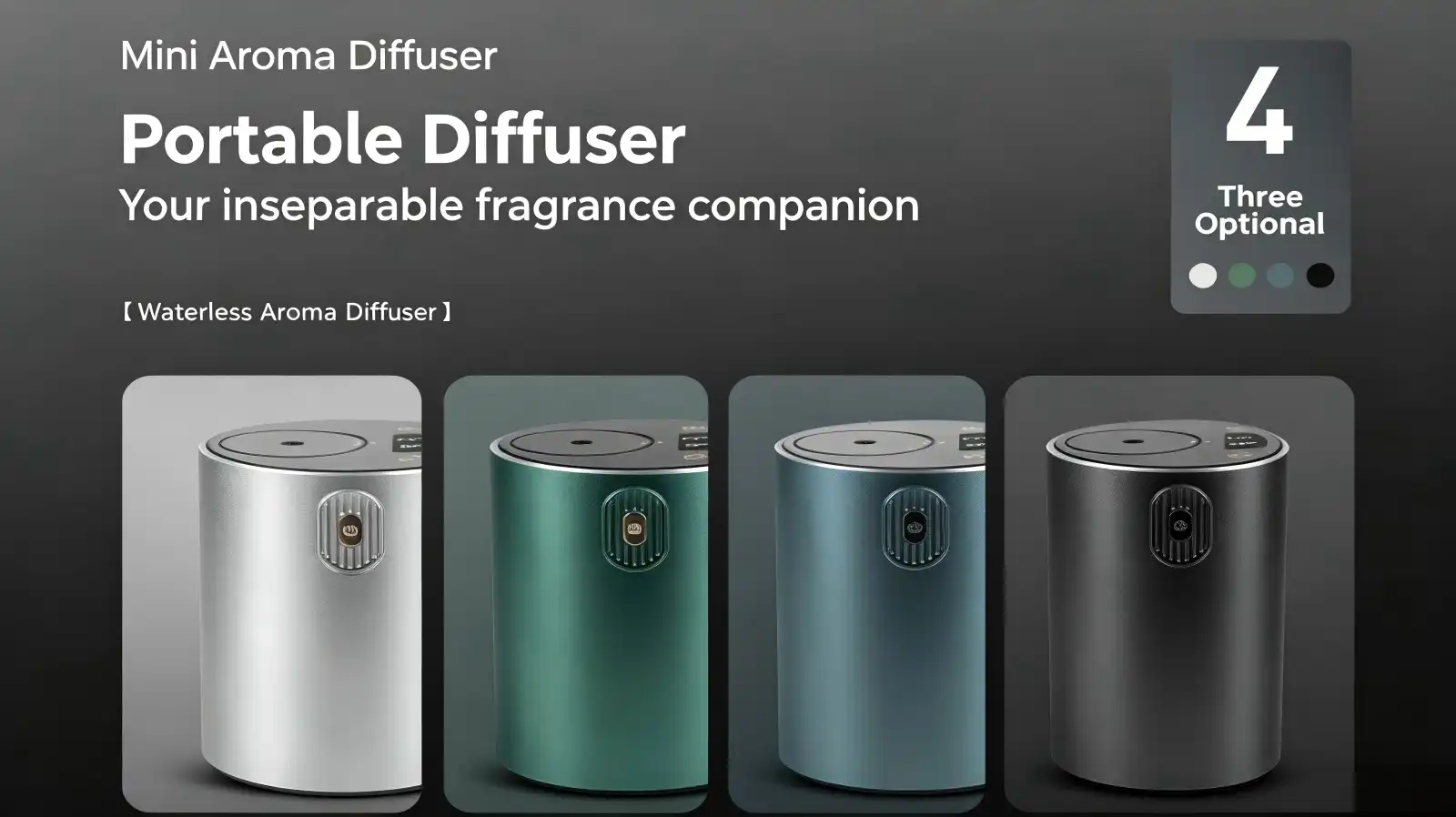
A Waterless Aroma Diffuser is generally a type of cold-air nebulizing device that disperses fragrance oil without using a water reservoir or heating element. Instead of evaporating diluted oil, the device uses airflow and a precision atomization structure to convert liquid oil into fine droplets.
Unlike ultrasonic systems, which normally combine water and fragrance oil, waterless systems deliver the oil in a more concentrated form. This difference can affect fragrance intensity, oil consumption, and the way the scent spreads through a room.
According to Chen, Park, and Zhao (2022), the operating principles of waterless and ultrasonic diffusion systems lead to different fragrance-delivery and maintenance characteristics, making technology selection dependent on the intended environment.[2]
It is also important to distinguish atomization from molecular breakdown. A diffuser does not normally "break apart" essential-oil molecules. Instead, mechanical forces divide the liquid into smaller droplets that can become suspended in the surrounding air.
Benefits for Commercial Applications
For B2B users, waterless diffusion can simplify some operational tasks because there is no water tank to refill or descale. This can be useful when several units are installed across different rooms or locations.
The technology may also be suitable for spaces where additional moisture is undesirable, such as retail displays, reception areas, vehicle interiors, offices, and some hospitality environments.
However, waterless does not mean maintenance-free. Oil residues can accumulate around the atomization pathway, particularly when highly viscous fragrance formulations are used. Regular inspection and cleaning, therefore, remain important.
For procurement teams, the more useful question is not whether a system requires maintenance, but how much labor, cleaning time, and consumable replacement it requires during normal operation.
How Does a Waterless Aroma Diffuser Work? (Systematic Deconstruction Approach)
Core Components and Engineering
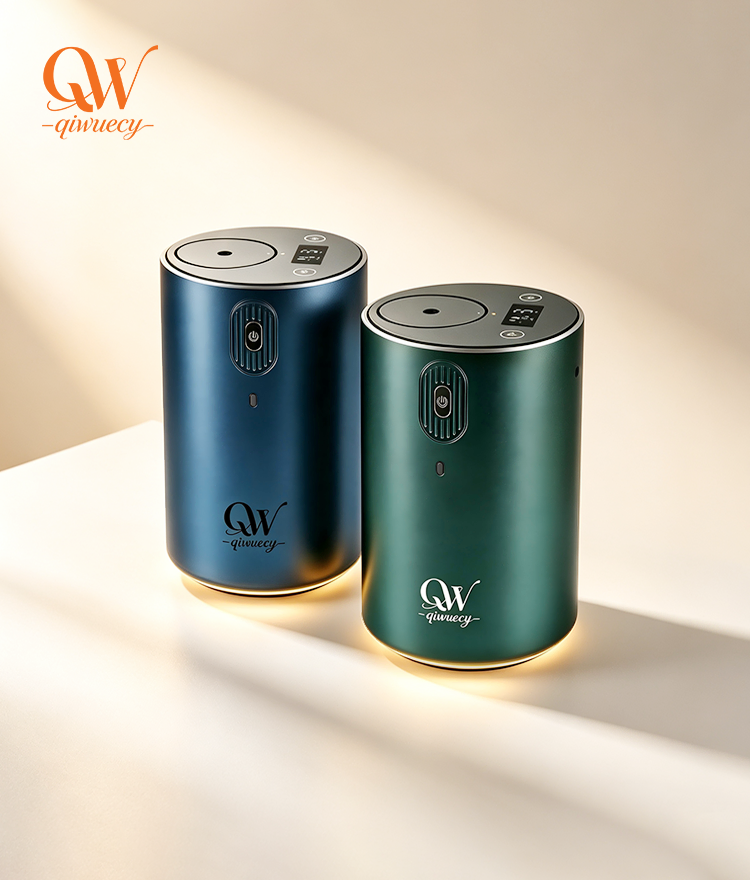
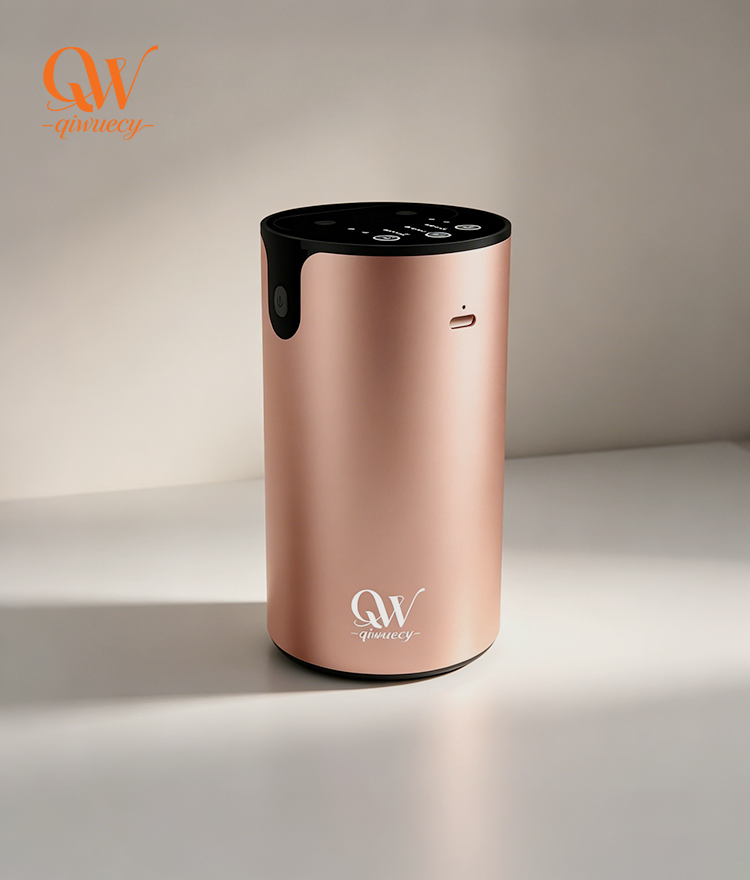
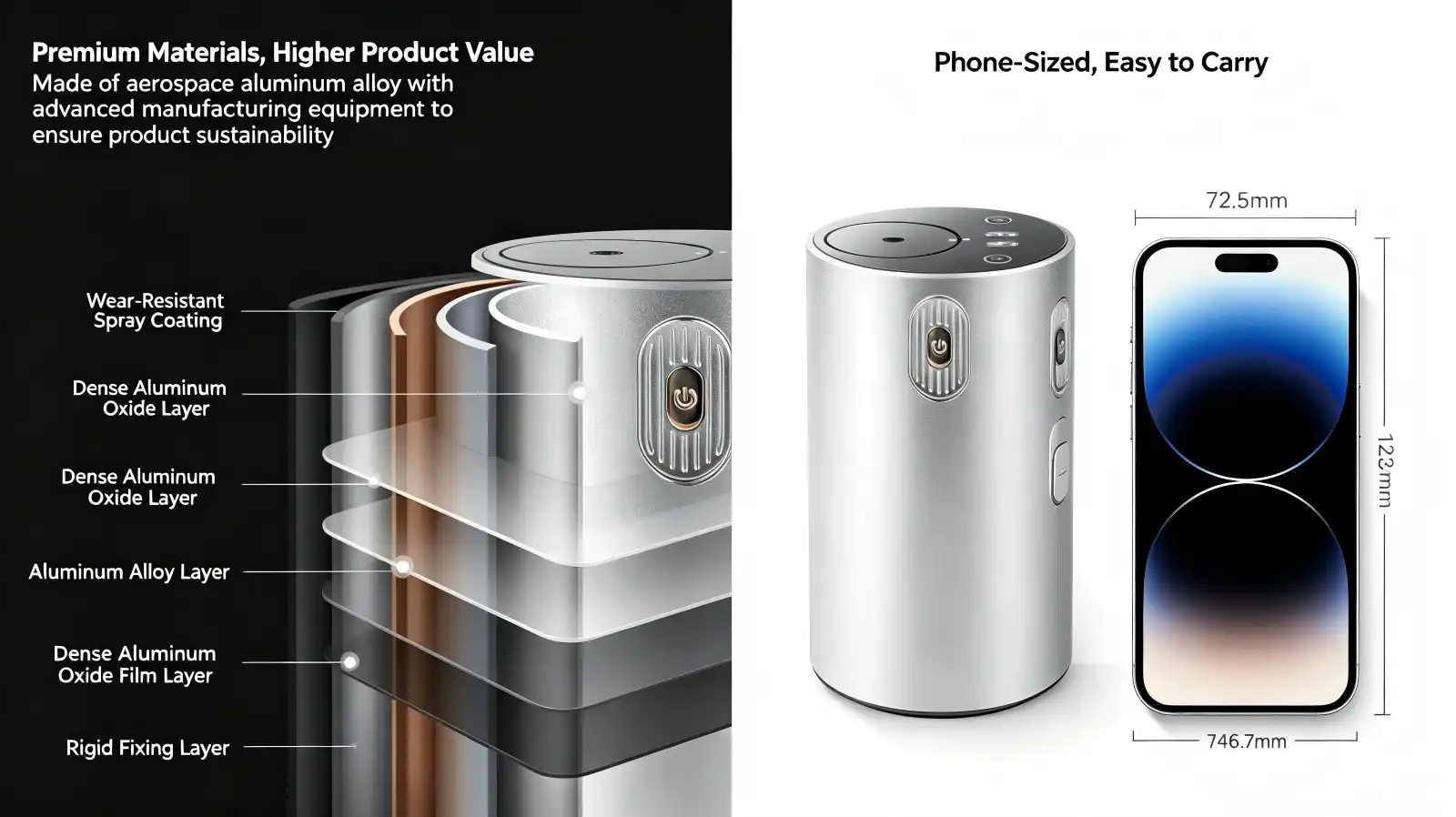
A professional Waterless Scent Diffuser typically combines a fragrance reservoir, airflow system, atomization nozzle, control electronics, and power source. The QW66 is an example of a compact design using PP, PBT, and aluminum-alloy components.
Its internal compressed-air system moves controlled airflow toward the atomization area. When air passes through a narrow passage, its velocity and pressure change. This airflow interacts with the liquid fragrance at the nozzle and helps separate the liquid into fine droplets.
The Venturi effect is relevant to many air-assisted atomization designs. Kumar and Nguyen (2021) explain that pressure and velocity changes in constricted airflow passages can be used to assist liquid movement and atomization in small-scale systems.[5]
The exact mechanism varies between products, so procurement teams should request a technical diagram or product specification sheet rather than assuming that every "waterless" diffuser uses the same internal structure.
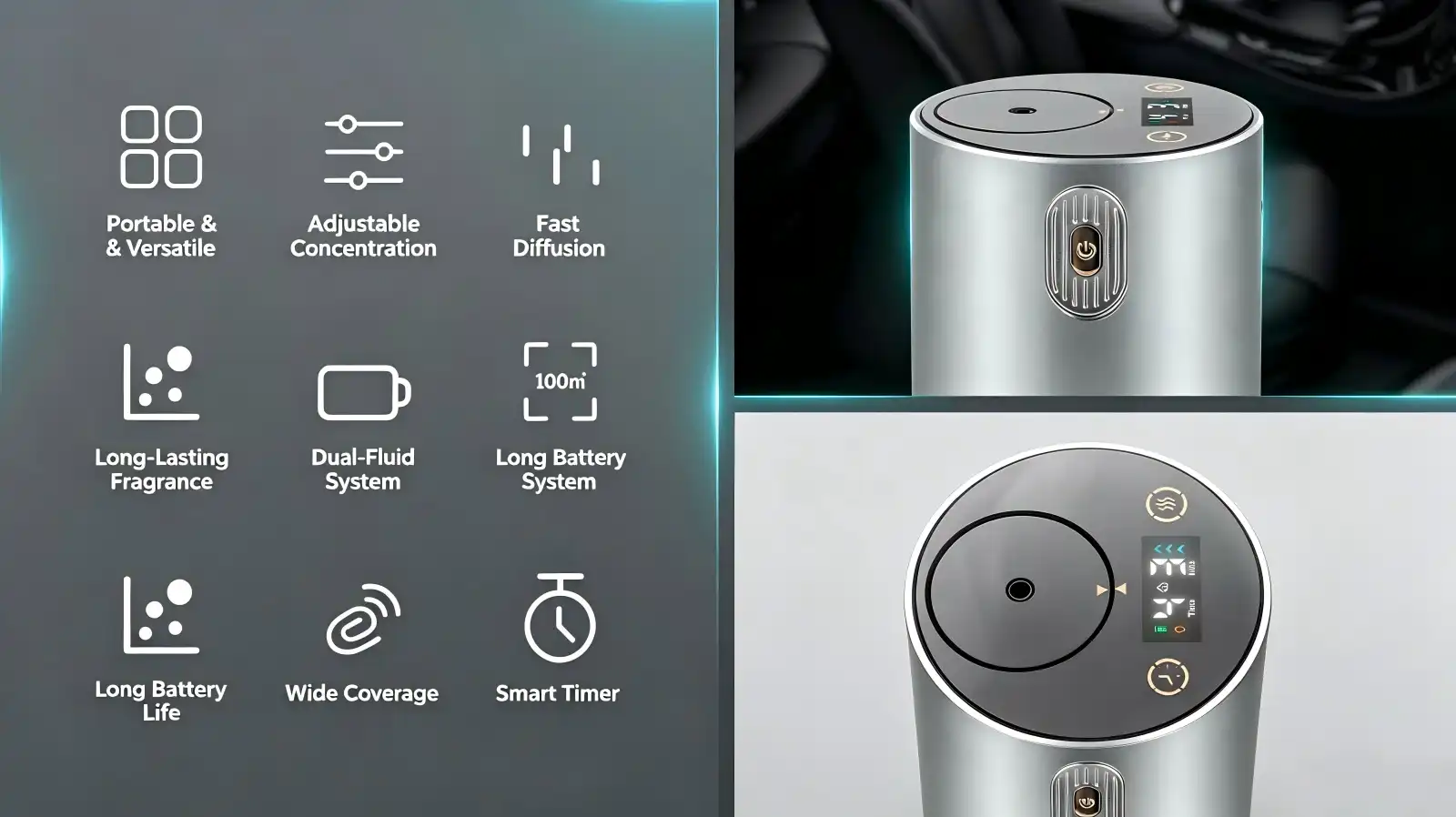
The QW66 combines portable operation, a rechargeable battery, adjustable timer functions, and dual Home/Car modes. Its compact format makes it suitable for applications where the diffuser may need to move between a vehicle, desk, reception area, or temporary display.
Step-by-Step Atomization Process
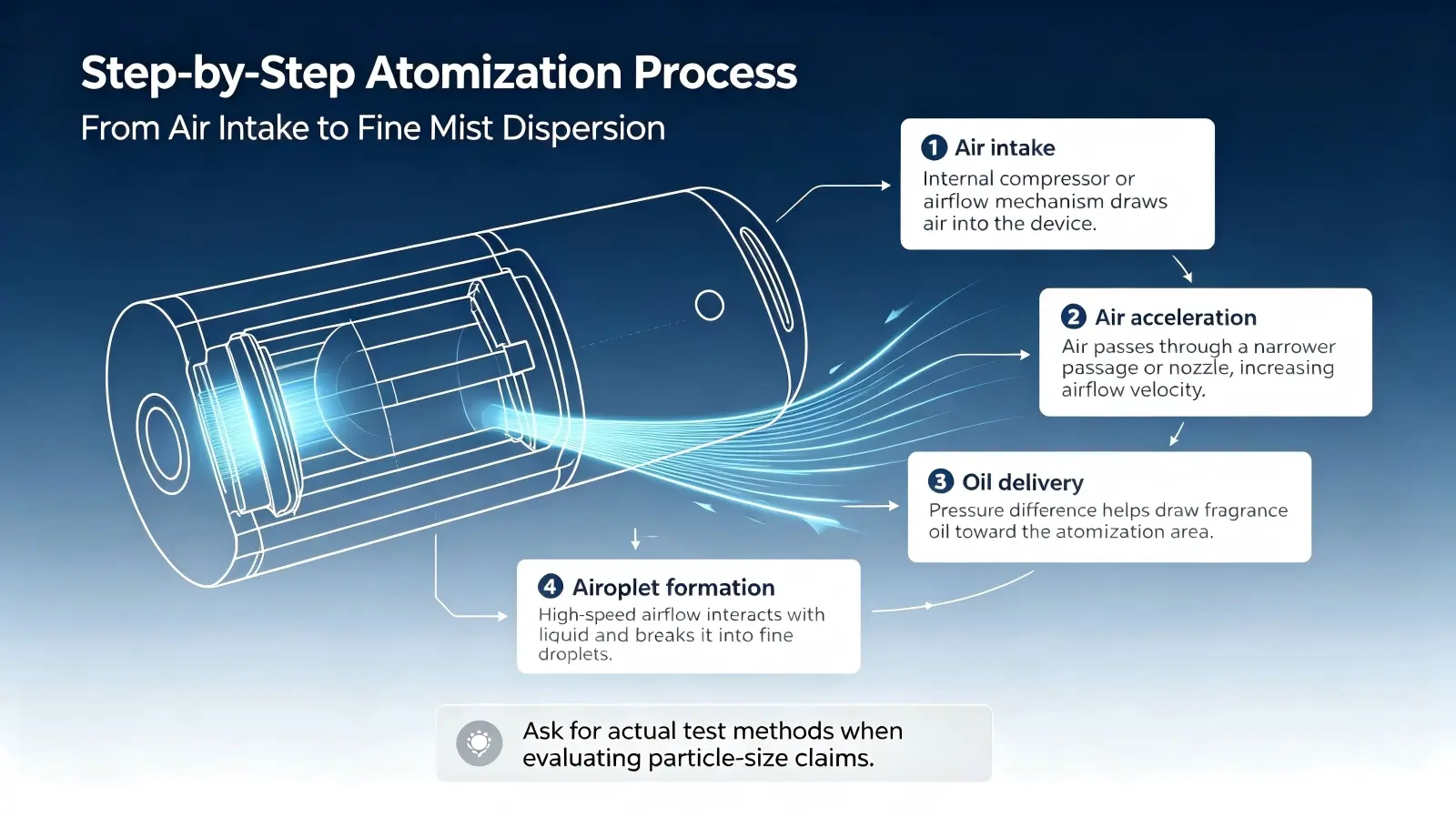
The working process can be simplified into several stages:
Step 1: Air intake
The internal compressor or airflow mechanism draws air into the device.
Step 2: Air acceleration
Air is directed through a narrower passage or nozzle, increasing airflow velocity.
Step 3: Oil delivery
The pressure difference helps draw fragrance oil toward the atomization area.
Step 4: Droplet formation
The high-speed airflow interacts with the liquid and breaks it into fine droplets.
Step 5: Airborne dispersion
The resulting mist exits the device and mixes with the surrounding air.
Particle size depends on nozzle geometry, airflow pressure, oil viscosity, and other design variables. Commercial diffuser specifications may describe output in the low-micron range, but a single particle-size figure should not be treated as universal performance data.
This is why buyers should request actual test methods when a supplier provides particle-size claims. The measurement technique, sampling conditions, fragrance formulation, and operating mode can all influence the result.
Real-World Application Case Study
A practical deployment illustrates why operating conditions matter. Consider a medium-sized open office using several waterless diffusers across different work zones. Rather than running every unit continuously, the facility team could divide the office into scent zones and use timer settings during occupied periods.
This approach reduces unnecessary operating time while allowing the team to compare fragrance distribution between different locations.
The result will depend heavily on room size, ventilation, ceiling height, furniture placement, fragrance formulation, and diffuser positioning. Therefore, a pilot installation is generally more informative than relying only on a supplier's maximum coverage figure.
For procurement teams, the useful data to collect during a trial includes fragrance consistency, oil consumption, operating noise, cleaning frequency, battery performance, and user feedback.
Waterless Aroma Diffuser vs. Other Diffuser Types (Rational Choice Approach)
Technical Comparison with Ultrasonic Models
Ultrasonic Waterless Scent Diffusers are not the same technology as waterless nebulizing systems. Traditional ultrasonic diffusers normally use vibration to create a mist from water and fragrance oil, while waterless systems use airflow-assisted atomization.[1]
The difference affects several procurement factors:
| Evaluation Factor | Waterless Diffuser | Ultrasonic Diffuser |
|---|---|---|
| Diffusion medium | Fragrance oil | Water and fragrance oil |
| Water requirement | None | Required |
| Fragrance concentration | Relatively concentrated | Diluted with water |
| Humidity contribution | Generally minimal | Adds water-based mist |
| Main maintenance | Oil pathway and atomizer | Water reservoir and atomizer |
| Refilling | Fragrance oil | Water and fragrance |
| Typical positioning | Commercial, automotive, premium scenting | Residential and localized scenting |
| Key procurement concern | Oil compatibility and atomization consistency | Reservoir maintenance and water quality |
According to Williams (2020), comparing diffusion equipment through total operating requirements rather than unit price alone can help hospitality and retail buyers make more practical purchasing decisions.[3]
Waterless technology can therefore be attractive when concentrated fragrance delivery and simplified water management are priorities. Ultrasonic systems may remain appropriate where a lower-cost, water-based mist is preferred.
Operational Advantages for B2B Clients
The biggest operational advantage of a waterless system is that it removes the need to manage a water reservoir. For multi-location businesses, this can simplify daily routines.
The QW66's rechargeable design and dual Home/Car mode also allow one product configuration to serve different applications. Battery runtime varies according to operating mode and intensity, but compact models can generally provide several hours of intermittent operation before recharging is required.
Noise should also be evaluated during actual testing. Rather than relying on a universal decibel figure, buyers should test the unit in the environment where it will be used. A sound level that seems acceptable in a showroom may be more noticeable in a quiet office, vehicle cabin, or meditation space.
Environmental and Health Benefits
Waterless operation can reduce routine water consumption because the diffusion process does not require a reservoir to be filled repeatedly.
The environmental impact, however, depends on the entire product lifecycle. Packaging, battery components, fragrance consumption, replacement parts, product lifespan, and end-of-life recycling all contribute to the overall footprint.
As García (2024) notes, sustainability in home-fragrance products increasingly involves material selection, packaging, product longevity, and end-of-life considerations rather than focusing on one product feature alone.[4]
For B2B buyers, this means sustainability claims should be evaluated across the complete supply chain.
Purchasing Guide: What to Look for When Procuring Waterless Aroma Diffusers (Criteria Screening Approach)
Assessing Business Requirements
Before requesting quotations, procurement managers should define the intended application. A retailer, hotel group, automotive accessory distributor, and private-label brand may require very different product configurations.
Instead of starting with unit price, establish the following requirements:
- Target room or vehicle size
- Expected daily operating hours
- Required battery or power configuration
- Preferred fragrance capacity
- Desired noise level
- Required customization
- Packaging requirements
- Expected order volume
- Target delivery schedule
- Replacement-part requirements
For e-commerce sellers, standard SKUs and repeatable packaging may be more important than extensive customization. OEM buyers may instead prioritize exclusive exterior designs, fragrance packaging, tooling, and branding.
Regional distribution also affects packaging, documentation, labeling, and logistics requirements. These should be confirmed with the supplier before production rather than assumed from a general product specification.
Key Product Specifications
Battery performance directly affects portability and user experience. The QW66 uses a rechargeable battery in the 2,000mAh class and operates at low power, but actual runtime depends on operating intensity, timer settings, battery condition, and ambient temperature.
Rather than asking only for battery capacity, buyers should request:
- Expected runtime under specific operating modes
- Charging time
- Battery replacement options
- Cycle-life test information
- Charging protection design
- Performance under different temperatures
Atomization consistency is another key consideration. Buyers should test the unit with the actual fragrance formulation they intend to sell or use.
Particle-size claims should also be interpreted carefully. As Zhang and Thompson (2024) discuss in their review of cold-air atomization developments, nozzle structure, airflow conditions, and system design can all influence atomization performance.[6]
Material selection matters as well. PP, PBT, aluminum alloy, glass, and other materials each have different characteristics relating to fragrance compatibility, impact resistance, appearance, and manufacturing cost.
Supplier Evaluation Criteria
Supplier capability should be evaluated using evidence rather than production claims alone.
| Evaluation Area | Questions Buyers Should Ask |
|---|---|
| Manufacturing | Can the supplier support the expected order volume? |
| Atomization | How is output consistency tested? |
| Materials | What materials are used in fragrance-contact areas? |
| Sampling | Can buyers test samples before mass production? |
| Customization | Which changes require new tooling? |
| Quality control | What inspections are performed before shipment? |
| Packaging | How are units protected during transport? |
| Spare parts | Are key components available separately? |
| After-sales | How are defective units handled? |
| Communication | Can the supplier provide clear technical documentation? |
For OEM projects, intellectual-property terms, mold ownership, design confidentiality, and change-control procedures should also be clarified before production.
A supplier with high production capacity can be useful, but capacity alone does not guarantee consistent product quality. Sample performance, communication, quality records, and delivery history should all be considered.
Maintenance and Longevity of Waterless Aroma Diffusers
Routine Cleaning Protocols
Waterless diffusers still require periodic maintenance because fragrance oils can leave residues inside the atomization pathway.
A practical maintenance routine may include:
- Checking the oil level regularly
- Cleaning the oil reservoir when changing fragrance types
- Inspecting the atomization nozzle
- Cleaning air-intake openings
- Checking cables and charging connections
- Inspecting the housing for physical damage
Cleaning procedures should follow the manufacturer's instructions because different atomization structures may require different cleaning agents or methods.
Battery storage also deserves attention. Lithium-ion batteries generally perform better when they are not repeatedly exposed to extreme temperatures or stored for long periods in a fully depleted state.
For products used in vehicles, buyers should pay particular attention to storage conditions because parked vehicles can experience substantial temperature fluctuations.
Troubleshooting Common Issues
If fragrance output becomes weaker, check the most straightforward causes first:
- The fragrance reservoir may be nearly empty.
- The atomization pathway may contain oil residue.
- The fragrance may be too viscous for the device.
- The battery may have insufficient charge.
- Air intake or exhaust openings may be obstructed.
If cleaning and recharging do not restore normal operation, the unit should be evaluated according to the supplier's troubleshooting procedure.
Timer settings can also cause confusion. A diffuser that stops after completing its programmed cycle may be operating normally rather than experiencing a malfunction.
For distributors, multilingual instructions and simple troubleshooting guides can reduce unnecessary support requests and make the product easier for customers to operate.
Conclusion
Waterless Aroma Diffuser technology works by using controlled airflow and an atomization structure to convert fragrance oil into fine airborne droplets without requiring water or heat. The core principle is relatively straightforward, but actual performance depends on nozzle design, airflow, oil viscosity, operating settings, and room conditions.
Compared with ultrasonic systems, waterless models remove the need for water management and can deliver fragrance in a more concentrated form. However, they still require appropriate cleaning, fragrance compatibility checks, and realistic performance testing.
For procurement teams, the most important evaluation points are not simply particle size or maximum coverage. Battery performance, atomization consistency, oil compatibility, noise, materials, packaging, customization, replacement parts, and supplier support should all be reviewed before a large order is placed.
A sample-first purchasing process is often the most practical approach: test the diffuser with the intended fragrance, evaluate it in a representative environment, review packaging, and then move toward a pilot order. This gives buyers a clearer picture of total operating costs and reduces the risk of scaling a product before its real-world performance is understood.
FAQ
1. What should buyers test before placing a bulk order?
Buyers should test fragrance output, oil consumption, operating noise, battery runtime, cleaning requirements, and packaging durability. Most importantly, test the diffuser with the actual fragrance formulation intended for production. A supplier's laboratory data or coverage claim may not fully represent performance in your specific environment.
2. Does a waterless diffuser require less maintenance than an ultrasonic model?
It can reduce some routine tasks because there is no water reservoir to refill or descale. However, oil residue can still accumulate around the atomizer. Procurement teams should compare total maintenance labor rather than assuming that waterless products require no maintenance.
3. How can OEM buyers reduce sourcing risks?
Start with samples, test the intended fragrance, confirm customization details, and review packaging before approving mass production. Buyers should also clarify tooling ownership, replacement parts, quality inspection procedures, lead times, and after-sales arrangements before signing a larger production order.
Partner with a Trusted Waterless Aroma Diffuser Manufacturer
Qiwuecy develops atomization-based products for fragrance brands, distributors, automotive accessory businesses, and OEM buyers. Its QW66 Waterless Aroma Diffuser combines a compact form factor with air-assisted atomization, rechargeable operation, and Home/Car modes.
For buyers evaluating a new waterless diffuser program, the practical starting point is product sampling. Testing the diffuser with the intended fragrance formulation can help determine whether its atomization performance, operating time, appearance, and maintenance requirements match the target application.
Qiwuecy can also support selected OEM/ODM requirements, including exterior customization, branding, packaging, and product configuration. Buyers can contact the team at marketing@qiwuecy.com to discuss product specifications, samples, and potential bulk or customized projects.
References
1. Thompson, M. & Richards, K. (2021). Advances in Cold-Air Nebulization Technology for Commercial Aromatherapy Applications. Journal of Industrial Fragrance Engineering, 14(3), 112–128.
2. Chen, L., Park, S., & Zhao, W. (2022). Comparative Analysis of Waterless vs. Ultrasonic Essential Oil Diffusion Systems in Commercial Environments. International Journal of HVAC and Environmental Control, 29(2), 67–85.
3. Williams, A. (2020). Procurement Strategies for B2B Aromatherapy Equipment: A Guide for Hospitality and Retail Sectors. Springer Publishing.
4. García, R. (2024). Sustainable Practices in Home Fragrance Manufacturing: A Case Study Approach. Green Business Quarterly.
5. Kumar, R. & Nguyen, T. (2021). Venturi Effect Applications in Micro-Scale Liquid Atomization: Engineering Principles and Performance Optimization. Mechanical Engineering Review, 8(1), 45–63.
6. Zhang, Y. & Thompson, K. (2024). Innovations in Cold-Air Atomization: Patent Landscape and Market Trends. Technology and Innovation Management Studies.
Online Message